How to Do Keyword Research with AI Tools (Step-by-Step 2026 Guide)
This post contains affiliate links. I may earn a commission at no extra cost to you.
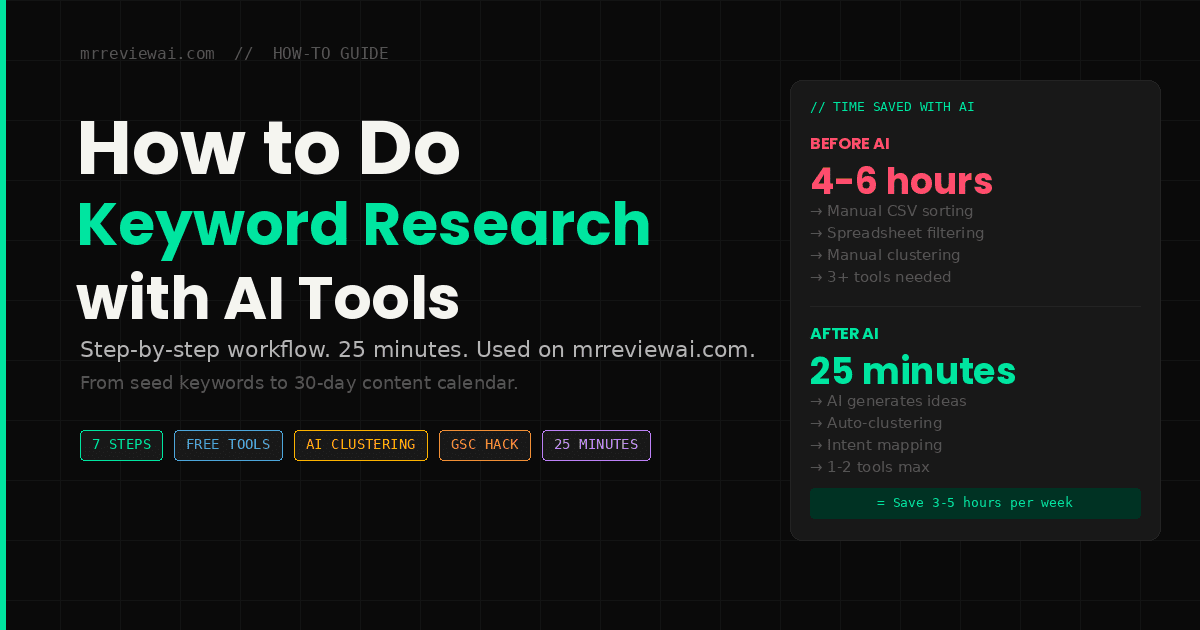
This guide shows you exactly how to do keyword research with AI tools — compressing what used to take 4 hours into 25 minutes.
Pull a list from Ahrefs. Export to a spreadsheet. Sort by volume. Filter by difficulty. Group manually. Stare at 400 rows and try to figure out what to write next.
Now I do it in 25 minutes. Same quality of research. Better keyword decisions. And I don’t touch a spreadsheet.
AI changed keyword research more than it changed writing. The process of finding the right keywords — the ones a new blog can actually rank for — used to require expensive tools and hours of manual work. In 2026, an AI tool can do the grouping, intent classification, and gap analysis in minutes.
This is the exact workflow I use on mrreviewai.com.
Table of Contents
- Why Traditional Keyword Research Is Broken in 2026
- What You Need Before You Start
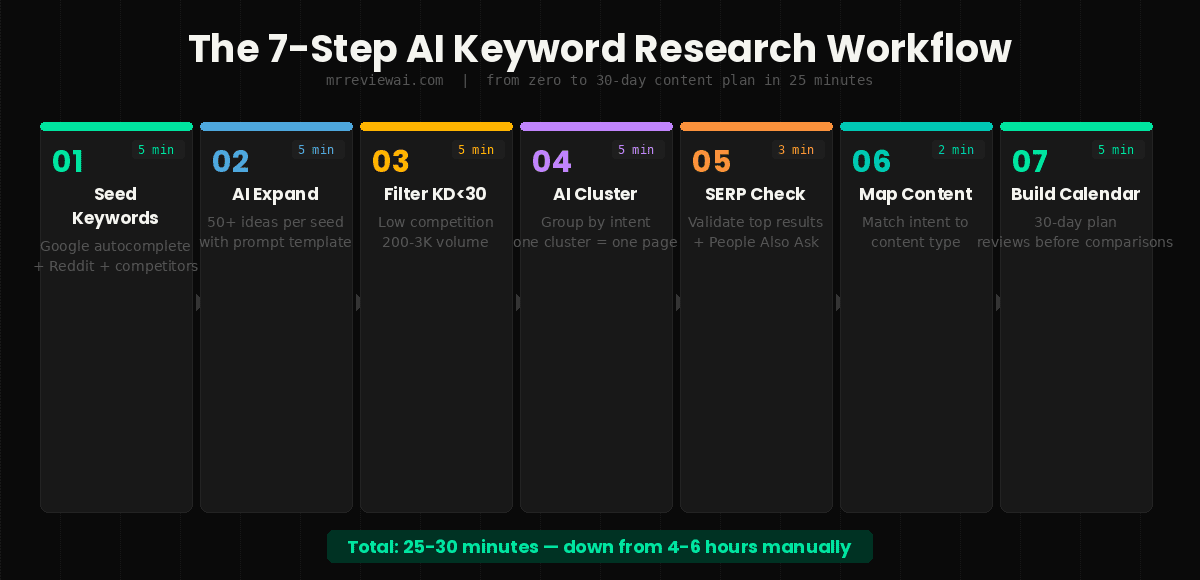
- Step 1: Find Your Seed Keywords (5 minutes)
- Step 2: Expand with AI — Generate 50+ Keyword Ideas Fast
- Step 3: Filter for Low-Competition Targets
- Step 4: Cluster Keywords by Intent with AI
- Step 5: Validate with Real SERP Data
- Step 6: Map Keywords to Content Types
- Step 7: Build a 30-Day Content Calendar
- The GSC Hidden Gem Technique — Free Traffic Hack
- Common Mistakes to Avoid
- FAQ
Why Traditional Keyword Research Is Broken (And How AI Tools Fix It)
The old workflow: open a keyword tool, type a seed term, export a CSV, sort by monthly search volume, filter by difficulty score, pick the best-looking ones.
That approach has three fundamental problems in 2026:
Problem 1: Volume numbers lie for new sites A keyword with 5,000 monthly searches and KD 35 looks winnable on paper. But KD scores don’t account for the authority gap between your new blog and the DR 60+ sites currently ranking. You’ll spend 3 months writing for a keyword you have zero chance of ranking for in year one.
Problem 2: Search is no longer just Google An estimated 15% of daily searches now happen in AI tools like ChatGPT (800M+ weekly users), Perplexity, and Google AI Overviews. Keywords that help you get cited in AI answers are different from keywords that just rank on page one. In 2026, serious bloggers optimize for both.
Problem 3: Manual clustering doesn’t scale If you’re publishing 20-30 articles per month, grouping keywords manually into topic clusters takes hours every week. AI does this in minutes — and does it better, because it understands semantic relationships rather than just lexical overlap.
The new approach: AI generates, clusters, and filters. You decide and create.
What You Need Before You Start
You don’t need expensive tools to start. Here’s the minimum stack:
Free:
- Google Search Console (your own site data)
- Google Autocomplete (free keyword ideation)
- ChatGPT or Claude (free tier works for clustering)
- Ahrefs Webmaster Tools (free — site audit + basic keyword data)
Budget-friendly ($9-16/month):
- Koala AI — SERP analysis + keyword-aligned drafting
- Writesonic — real-time web data + keyword research
When your blog earns $500+/month:
- RankIQ ($49/month) — curated low-competition keyword library for bloggers
- Ahrefs Starter ($29/month) — full keyword data
You don’t need Ahrefs vs Semrush at $130+/month yet. Start with free tools and upgrade when the ROI justifies it.
Step 1: Find Your Seed Keywords (5 Minutes)
A seed keyword is your starting point — a broad topic in your niche that you’ll expand from.
How to generate seed keywords:
Start with what your audience is searching for. For mrreviewai.com, the niche is AI tools for bloggers and online entrepreneurs. So my seeds are things like:
- “AI writing tools”
- “best SEO tools”
- “how to make money blogging”
- “AI for content creation”
Three places to find seeds quickly:
1. Google Autocomplete Type a broad topic into Google. Don’t press Enter — look at the autocomplete suggestions. These are real searches people make. Each suggestion is a potential seed.
2. Reddit and Forums Go to r/blogging, r/SEO, or r/affiliatemarketing. Search your topic. Look at the questions people ask repeatedly — these are keywords with real demand behind them.
3. Competitors’ Top Pages Find a blog in your niche. Paste their URL into Ahrefs Webmaster Tools (free). Look at which pages get the most traffic. Those pages’ topics are your seeds.
Collect 5-10 seeds. You’ll expand each one in the next step.
Step 2: Use AI Tools for Keyword Research — Generate 50+ Ideas Fast
This is where AI saves the most time in keyword research. Instead of manually brainstorming variations, you prompt an AI tool to generate a comprehensive list — this is how to do keyword research with AI tools at scale.
The prompt that works:
Open ChatGPT or Claude and paste this:
“I’m building a blog in the [your niche] niche targeting [your audience]. My seed keyword is ‘[seed keyword]’. Give me 40 keyword variations including:
- Informational keywords (how-to, what is, guide)
- Commercial keywords (best, review, comparison, alternatives)
- Transactional keywords (pricing, discount, free trial)
- Long-tail variations (3-5 word phrases)
- Question-based keywords (who, what, why, how, when) Format the list by category.”
Example output for “Koala AI”:
Informational: “what is koala ai”, “how does koala ai work”, “koala ai tutorial for bloggers” Commercial: “koala ai review 2026”, “best koala ai alternatives”, “koala ai vs writesonic” Transactional: “koala ai pricing”, “koala ai free trial”, “koala ai discount code” Long-tail: “koala ai for affiliate content”, “koala ai amazon product roundup” Questions: “is koala ai worth it”, “does koala ai pass ai detection”
In 2 minutes, you’ve generated 40+ keywords from one seed. Repeat this for each of your 5-10 seeds and you’ll have 200-400 keyword ideas to work with.
Step 3: Filter for Low-Competition Targets
More keywords is not better. 400 keywords you can’t rank for is worthless. 20 keywords you can rank for in 6 months is everything.
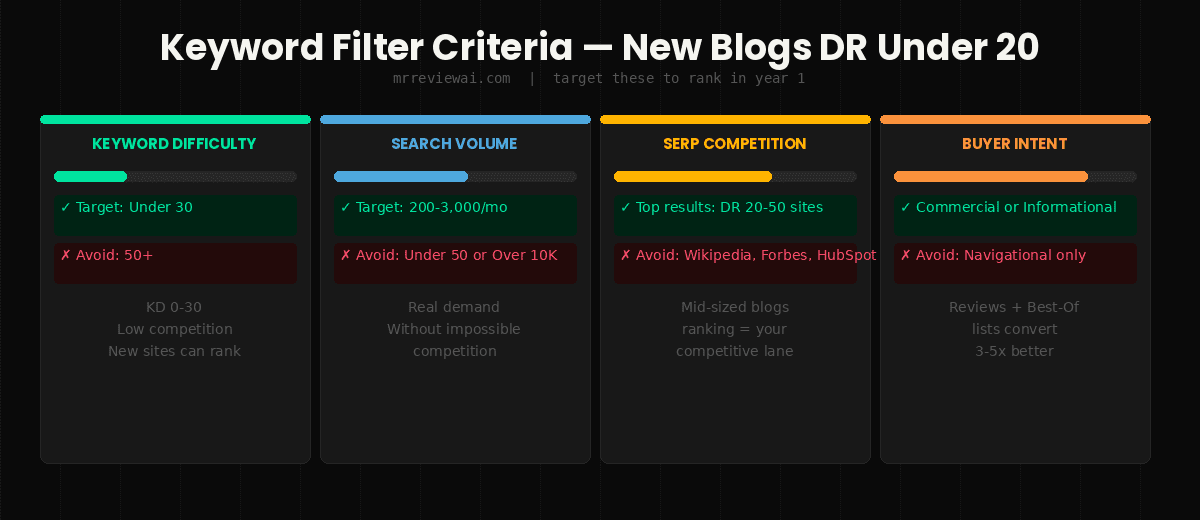
The filter criteria for new blogs (DR under 20):
Target keywords where:
- Keyword Difficulty (KD) is under 30 — low competition
- Monthly search volume is 200-3,000 — real demand without impossible competition
- Top-ranking pages are from mid-sized blogs (DR 20-50), not huge media sites
- The keyword has clear buyer intent — someone searching is close to making a decision
How to check without paying $130/month:
Ahrefs Webmaster Tools (free): Check keyword difficulty for your own site’s rankings. Not ideal for research, but gives you data on what you’re already ranking for.
Google SERP eyeball test (free): Search your keyword. Look at the top 5 results. Are they from:
- Wikipedia, Forbes, HubSpot, Investopedia? → Too competitive for now
- Mid-sized review blogs, personal sites, small businesses? → Potentially winnable
Koala AI’s SERP analysis ($9/month): Scans competitor pages before writing. Shows you what’s ranking and gives you a structural blueprint to compete.
The quick filter rule: If a keyword has the top 5 results dominated by sites with 100K+ monthly visitors, skip it for now. Come back in 12 months when your site has authority.
Step 4: Cluster Keywords by Intent with AI
This step changes how you think about content planning. Instead of one page per keyword, you think in clusters — groups of related keywords that one well-written page can rank for simultaneously.
Why clustering matters:
Google understands that “best AI writing tools“, “top AI writing tools 2026”, and “AI writing tools for bloggers” are all expressions of the same search intent. One good page targeting the primary keyword naturally picks up all three. Writing three separate pages splits your authority and creates cannibalization.
The AI clustering prompt:
Paste your filtered keyword list into Claude or ChatGPT:
“Group these keywords into clusters based on the underlying user need they represent. Each cluster should correspond to one single page that can comprehensively cover all keywords in the group. For each cluster:
- Name the primary keyword (highest relevance + volume)
- List supporting keywords
- Identify the search intent (informational / commercial / transactional)
- Suggest the content type (review / best-of / how-to / comparison)”
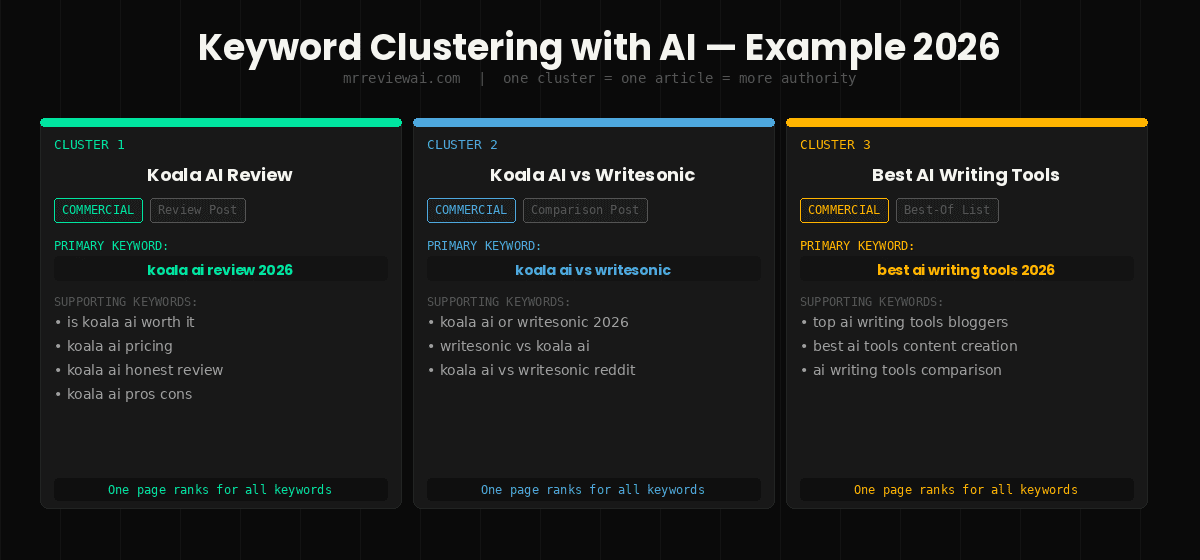
Example cluster output:
Cluster: Koala AI Review
- Primary keyword: “koala ai review 2026”
- Supporting: “is koala ai worth it”, “koala ai pricing”, “koala ai honest review”
- Intent: Commercial — reader is deciding whether to buy
- Content type: Review post (1,800+ words)
Cluster: Koala AI vs Writesonic
- Primary keyword: “koala ai vs writesonic”
- Supporting: “koala ai or writesonic”, “koala ai vs writesonic 2026”
- Intent: Commercial — reader is comparing two specific tools
- Content type: Comparison post
One cluster = one article. This is how mrreviewai.com’s 30-article content calendar was built.
Step 5: Validate with Real SERP Data
AI-generated keyword ideas are a starting point — not a guarantee. Before committing to writing a 2,000-word article, spend 5 minutes validating the keyword against real Google data.
Validation checklist:
☐ Search the keyword on Google — Do the results match what you planned to write? If you planned a product review but the SERP shows comparison tables, adjust your content type.
☐ Check “People Also Ask” — These questions are exactly what people want answered. Include them in your article’s FAQ section for featured snippet opportunities.
☐ Check “Related Searches” at the bottom — These are the supporting keywords for your cluster. Add them naturally throughout your article.
☐ Look at featured snippets — If a featured snippet exists for your keyword, that’s your target. Structure your answer to beat it: direct, concise, under 40 words immediately after your H2 heading.
☐ Check Google Search Console (if site is established) — Filter for queries where your average position is 8-20. These are your “quick win” keywords — you’re already ranking, just not on page one. Update those pages before writing new ones.
Step 6: Map Keywords to Content Types
Not all keywords deserve the same content format. Matching keyword intent to content type is what separates posts that rank from posts that don’t.
| Intent | Keyword Example | Best Content Type | Target Length |
|---|---|---|---|
| Commercial | “jasper ai review 2026” | Product review | 1,800-2,500 words |
| Commercial | “jasper vs copy.ai” | Comparison post | 2,000-3,000 words |
| Commercial | “best ai writing tools” | Listicle / best-of | 2,500-4,000 words |
| Informational | “How to Use AI to Write Blog Posts“ | How-to guide | 1,500-2,000 words |
| Informational | “Surfer SEO“ | Explainer / definition | 1,000-1,500 words |
| Transactional | “koala ai pricing” | Pricing page or section | 800-1,200 words |
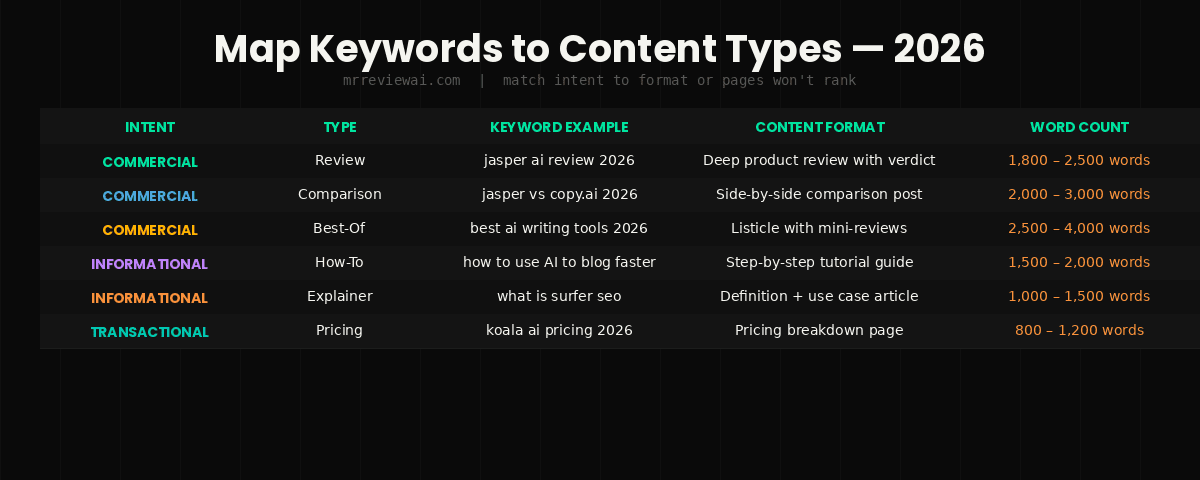
The rule for affiliate blogs: Prioritize commercial intent keywords first — they convert at 3-5x the rate of informational keywords. Reviews, comparisons, and best-of lists are where your affiliate commissions come from.
Step 7: Build a 30-Day Content Calendar
With your clusters mapped and content types assigned, the final step of how to do keyword research with AI tools is building a 30-day calendar — which takes 20 minutes.
The formula:
- 12 review posts (1 tool per post)
- 6 comparison posts (tool A vs tool B)
- 6 best-of lists (category roundups)
- 6 how-to guides (practical tutorials)
How to sequence them:
Publish a review before the comparison. If you’re writing “Jasper AI vs Copy.ai”, publish the Jasper review and the Copy.ai review first. Then link both to the comparison. This builds internal linking structure and topical authority simultaneously.
Use AI to write the calendar:
“Based on these 30 keyword clusters [paste list], create a 30-day content publishing schedule. Sequence reviews before comparisons. Schedule best-of lists in weeks 2 and 4. Include URL slugs and primary keywords for each article.”
In 2 minutes you have a complete editorial calendar — ready to execute.
The GSC Hidden Gem Technique — Free Traffic Hack
This is the highest-ROI keyword technique for blogs that have been publishing for 3+ months.
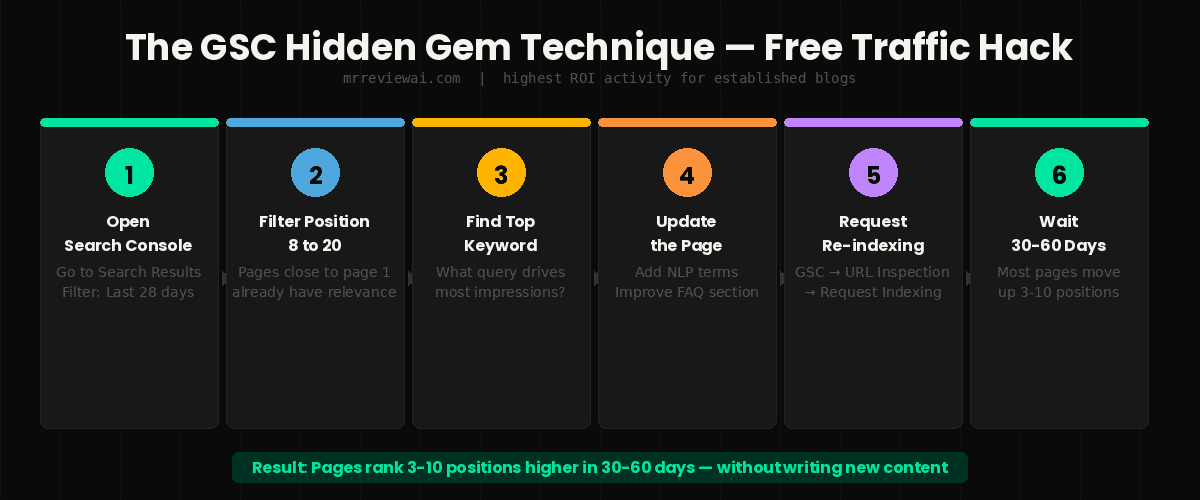
The workflow:
- Open Google Search Console → Search Results
- Filter by: Average Position between 8 and 20
- Look at which pages are showing on page 2-3 of Google
- These pages already have topical relevance — Google just needs more confidence
- Update those pages: add missing NLP terms, increase word count, improve FAQ section
- Submit updated URL for re-indexing in GSC
- Wait 30-60 days
Most pages updated this way move up 3-10 positions. That means pages currently ranking #12 hit page one — without writing a single new article.
For mrreviewai.com, this technique will become the highest-leverage activity starting around month 4-5, once we have enough indexed content to generate meaningful GSC data.
Common Mistakes to Avoid
Mistake 1 when you learn how to do keyword research with AI tools: Targeting keywords with search volume over 5,000 on a new site High-volume keywords are dominated by established sites. You’re not going to outrank HubSpot in year one. Start with 200-1,000 monthly searches. Build authority. Scale up.
Mistake 2: Ignoring search intent Writing a product review for a keyword where Google shows comparison tables means your content won’t match what searchers want — and won’t rank, regardless of quality.
Mistake 3: One keyword, one article — no clustering This fragments your topical authority. One comprehensive cluster page outperforms three thin pages targeting variations every time.
Mistake 4: Trusting AI keyword data without SERP validation AI generates keyword ideas. It doesn’t verify search volume or competition in real time. Always run your top targets through Google’s SERP before committing to a full article.
Mistake 5: Never revisiting your keyword strategy Search trends shift. Every 90 days, check your GSC data for new opportunities and declining pages. Keyword research isn’t a one-time task — it’s an ongoing system.
The Tool That Does Steps 1–7 Automatically: Frase.io
If you want to automate the entire keyword research → SERP analysis → content brief workflow, Frase.io is worth looking at. Type in a target keyword, and Frase instantly shows you what the top 20 ranking articles cover — headings, questions, word counts, and content gaps — all without manually Googling anything.
It essentially compresses Steps 2, 5, and 6 of this guide into a single screen. For bloggers writing 4+ articles per week, that’s a significant time saver. You still need to bring the original angle and personal experience — but Frase handles the research scaffolding.
FAQ
Can I do keyword research with just free AI tools? Yes — for ideation and clustering, ChatGPT or Claude (free tier) plus Google Autocomplete and Google Search Console covers most of what a new blogger needs. The limitation is that free AI tools don’t give you verified search volume data. For that, you need a tool like Ahrefs Starter ($29/month) or RankIQ ($49/month) once your blog is generating income.
How long does AI keyword research take? Using the workflow in this guide: 20-30 minutes to generate and cluster 200+ keyword ideas, validate top targets, and map a 30-day content calendar. Traditional manual keyword research for the same output takes 3-5 hours.
What is keyword clustering and why does it matter? Keyword clustering groups related keywords by search intent so one well-written page can rank for multiple variations simultaneously. It prevents cannibalization (multiple pages competing for the same keyword), builds topical authority, and maximizes the return on each article you write.
How do I know if a keyword is too competitive for my new blog? Check the top 5 results: if they’re from sites with 100,000+ monthly visitors (you can estimate this by pasting the URL into Ahrefs Webmaster Tools), skip the keyword for now. Target keywords where mid-sized blogs (DR 20-50) are ranking — that’s your competitive lane in year one.
Should I focus on Google or AI search keywords in 2026? Both. Google organic traffic is still your primary target for affiliate conversions. But include a “Golden Answer” format in your articles — a direct, concise answer immediately after your H2 headings — which helps you get cited in ChatGPT and Perplexity. One format, two audiences.
How often should I do keyword research? Full keyword research sprint: once per quarter. Weekly: check Google Search Console for new ranking opportunities and declining pages. Monthly: update your content calendar based on what’s working and what isn’t.
The process I’ve described here replaced a 4-hour manual workflow with a 25-minute AI-assisted one. But the output — a prioritized keyword list, clustered by intent, mapped to content types — is better than what I produced manually.
Start with the free tools. Build the habit. Add paid tools as your blog’s income justifies the investment.
One good keyword decision today is worth more than 50 mediocre articles targeting the wrong terms.
👉 Try Koala AI Free — SERP-Aligned Content from $9/month → 👉 Try Ahrefs Webmaster Tools Free — No Credit Card →
Published by mrreviewai.com | Last updated: May 2026 Workflow tested across mrreviewai.com and multiple affiliate sites.
Frequently Asked Questions About Keyword Research with AI
Can ChatGPT or Claude actually help with keyword research?
Yes, but not the same way dedicated tools can. I use Claude AI to brainstorm keyword clusters and identify what questions people have around a topic. Then I validate the actual search volume and difficulty in Ahrefs before writing. AI for ideation, dedicated tools for the real data.
How long should keyword research take per article?
With AI tools helping with ideation and a keyword tool for validation, I spend about 20 to 30 minutes on keyword research per post. Without AI, I used to spend 1.5 to 2 hours on the same task. That time saving across 50 posts per year is significant.
What keywords should a brand new affiliate blog target first?
Start with long-tail keywords that have fewer than 1,000 monthly searches and keyword difficulty under 20. I know it feels like small numbers, but a page ranking in position 1 for a 500-search keyword can earn real commissions. Stack 30 of these and you have meaningful monthly traffic.
Can I do keyword research without spending any money?
Yes. I did it for my first four months. Google Keyword Planner, AnswerThePublic, and Google Search autocomplete are all free. The limitation is speed and accuracy, not viability. Free tools work. Paid tools work faster. Start free, upgrade when your blog starts earning.
How many keywords should I target per post?
One primary keyword and three to five related secondary keywords per post. Going beyond five makes it hard to stay focused on a single topic, and unfocused articles tend to rank for nothing. One clear topic, executed well, is the formula that actually works for affiliate blogging.
🎁 Free Weekly AI Tool Picks
Join 1,000+ bloggers getting tested AI tool recommendations every week. No spam, unsubscribe anytime.