How to Write a Product Review That Ranks: Best 2026 Guide
Tools mentioned in this post are ones I personally use. No affiliate partnerships at the time of publishing.
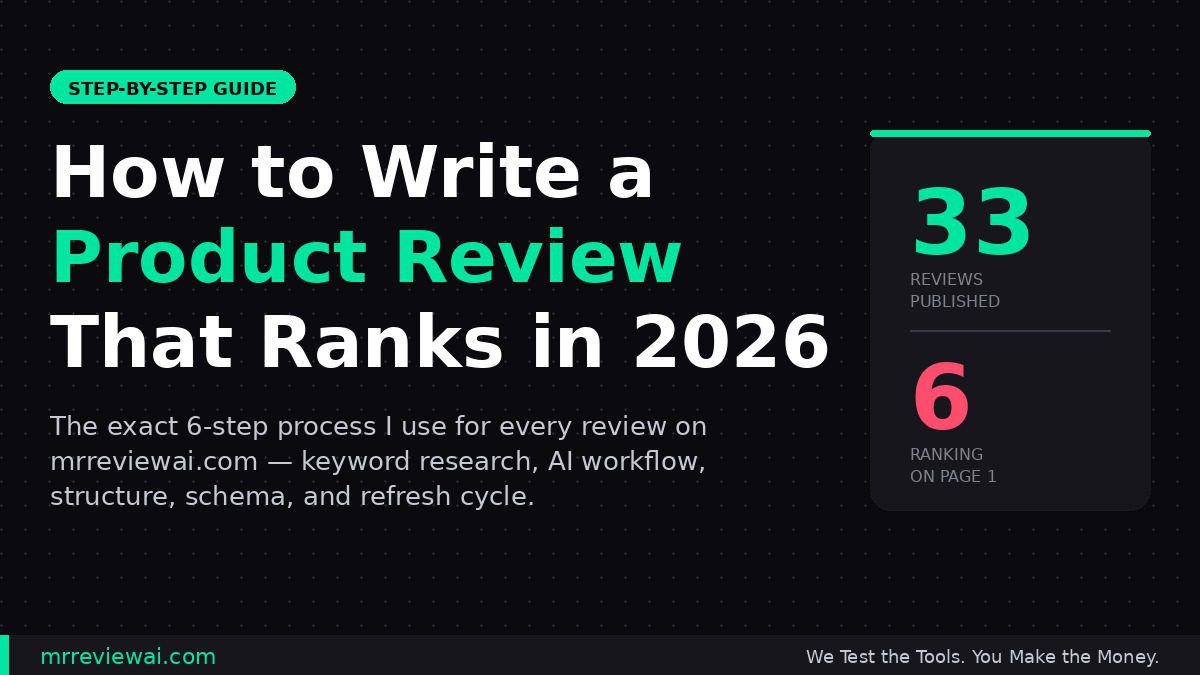
How to write a product review that ranks on Google in 2026 isn’t about word count or hacks — it’s about six structural signals Google’s algorithm explicitly rewards. I’ve published 33 product reviews on this site over the past few months. Some rank. Some don’t.
The ones that rank share six things in common. The ones that don’t all made the same mistakes — mistakes I made myself before I figured out what Google’s 2026 product review update actually rewards.
This is the exact process I now use for every review I write, including the workflow, the structure, and the AI tools that cut my writing time from 6 hours to 90 minutes per review.
If you’re writing affiliate reviews and getting buried on page 4 of Google, this is what’s missing.
Quick Verdict — What Actually Makes a Product Review Rank in 2026
Tested: 33 published reviews, 4 months of data, 6 reviews now ranking page 1 Best for: Affiliate bloggers earning $0–$3K/month who write product reviews Skip this guide if: You don’t actually use the products you review (Google’s algorithm will catch you)
The short answer: A product review ranks in 2026 when it has (1) genuine first-hand usage signals, (2) a verdict box optimized for AI Overviews, (3) honest limitations, (4) specific outcomes with numbers, (5) proper Review schema, and (6) a clear intent match between your structure and what searchers actually want.
That’s it. The rest of this post breaks down exactly how to do each one.
Table of Contents
- Why most product reviews fail to rank
- Step 1 — Choose the right review keyword before you write anything
- Step 2 — Research the product like a power user
- Step 3 — Structure your review for Google AND human readers
- Step 4 — Write each section with intent-matching content
- Step 5 — SEO optimization after writing
- Step 6 — Publish, update, and watch rankings climb
- FAQ
How to Write a Product Review That Ranks: Why Most Fail First
I’ll save you the suspense. Most reviews fail because they look like every other review on page 1.
In 2026, Google rolled out the third major iteration of its product reviews system. The signal it now hunts for is first-hand experience — evidence that the writer actually used the product, not just paraphrased the sales page.
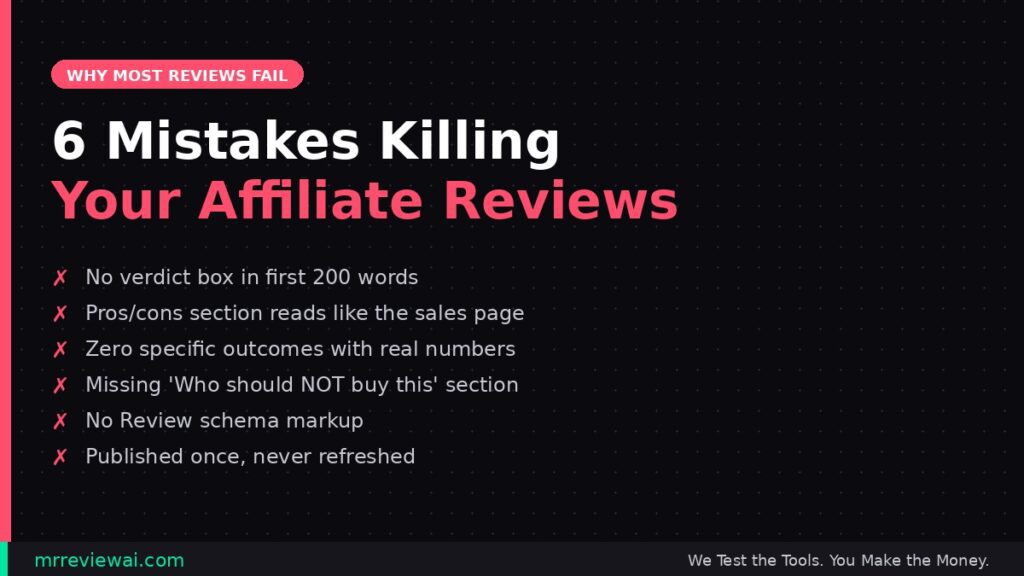
Here’s what failing reviews have in common (I know because I’ve written several of them):
- The intro starts with “Today I’m reviewing…” — zero hook, zero pain point
- The “pros and cons” section reads like the product’s own marketing page
- No specific outcomes with real numbers
- No mention of who should NOT buy the product
- No verdict box at the top — readers and AI engines have to dig for the answer
- Word count padded to “hit 2,000 words” with filler
The reviews that rank do the opposite. They lead with a specific pain point, give the verdict in the first 200 words, and use real usage data (timing, outputs, screenshots, dollar amounts) throughout.
Now let’s build one.
Step 1 — Choose the Right Review Keyword Before You Write Anything
This is where 90% of affiliate writers lose before they start.
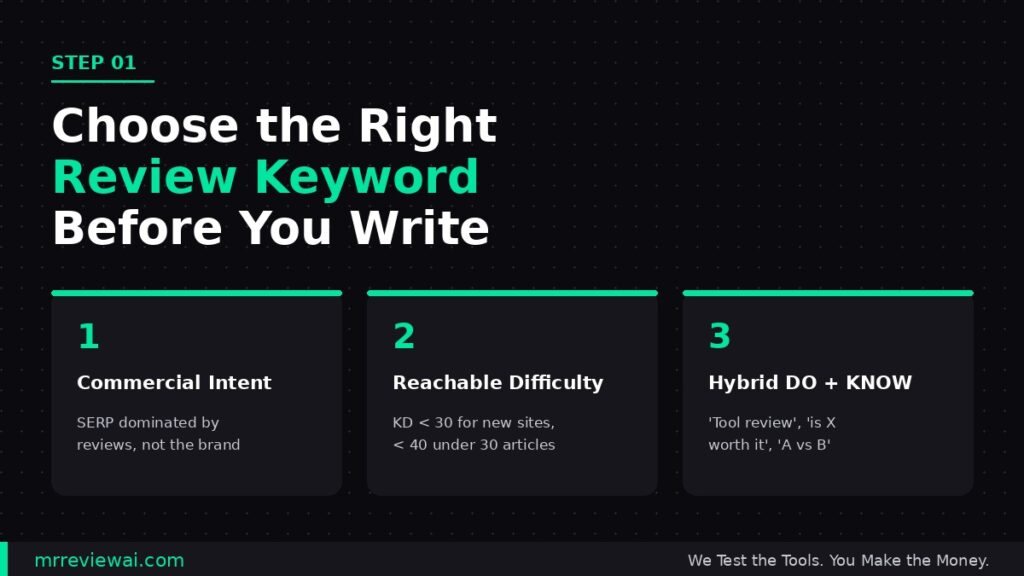
A review keyword has three components you need to verify before opening Google Docs:
1. The keyword has commercial intent Look at the SERP. If page 1 is dominated by other reviews and comparison posts (not the product’s own website), you’re in a winnable spot. If page 1 is mostly the brand’s own pages, the keyword is too top-of-funnel for an affiliate site.
2. The keyword has reachable difficulty For a site under 6 months old, target KD 30 or below in tools like Ahrefs or Semrush. For a site under 30 articles, stay under KD 40. Going higher means waiting 12+ months for results.
3. The keyword matches a hybrid DO + KNOW intent Pure transactional (“buy [product]”) goes to the brand. Pure informational (“what is [product]”) goes to the brand or Wikipedia-style sites. The sweet spot is hybrid — searchers want to learn AND decide. Examples:
- “[Product] review”
- “Is [product] worth it”
- “[Product] vs [competitor]”
- “[Product] for [specific use case]”
My current keyword research workflow:
I use Ahrefs for SERP analysis and difficulty scoring, then cross-check volume in Semrush because the two tools often disagree by 30–50%. If both show traffic potential and KD under my threshold, the keyword goes into my content calendar.
If you don’t have a budget for paid tools yet, the free version of Ubersuggest plus Google’s “People Also Ask” box will get you 70% of the way there for the first 30 articles.
Step 2 — Research the Product Like a Power User
This is the step that separates reviews that rank from reviews that don’t.
You cannot write a ranking review of a product you haven’t used. Google’s reviewer-quality signals look for:
- Original screenshots from inside the tool
- Specific outputs you generated
- Time-bound usage (e.g., “after 30 days of daily use”)
- Workflow details only a real user would know
- Honest friction points
If you can’t get a free trial or paid access, pick a different product. Affiliate income isn’t worth tanking your site’s authority on a fake review.
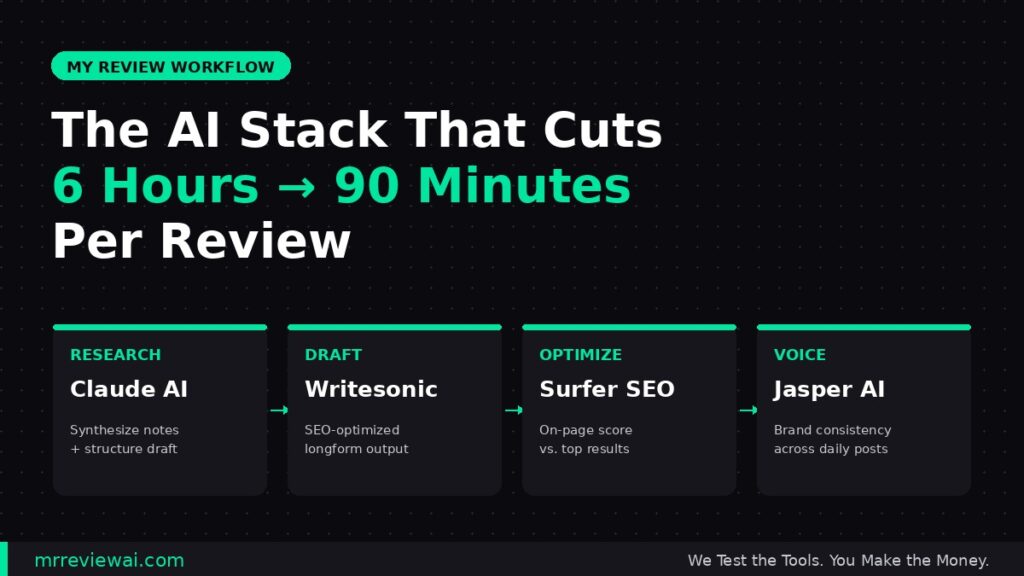
How I Use Claude AI to Research in 10 Minutes
Once I have access to the product, I do this:
- Sign in and complete a real task. Not a 5-minute test — an actual workflow I’d do for my site (e.g., draft an article, run a keyword analysis, generate a comparison table).
- Screenshot the friction. Every time something confuses me, slows me down, or breaks, I capture it. These become real limitation points later.
- Time my workflow. I literally use a timer. “Drafted a 1,400-word article in 11 minutes” is the kind of specific data that creates information gain.
- Use Claude AI to synthesize my notes into the review skeleton. I paste in my raw observations, my screenshots’ context, and the keyword data — Claude turns it into a structured first draft that I then heavily edit with my own experience and specific outcomes.
The key insight: AI tools are excellent for structure. They’re terrible for authenticity. Your job is to inject the authentic experience that AI can’t fake.
For drafting and rewriting the prose itself, I switch between Writesonic (better for SEO-optimized longform) and Claude (better for honest, conversational sections). Jasper AI is in the rotation when I need brand-voice consistency across a 30-day publishing schedule.
Step 3 — Structure Your Review for Google AND Human Readers
Google’s 2026 product review update explicitly rewards reviews that are easy to scan and easy for AI Overviews to cite. Structure does most of that work.
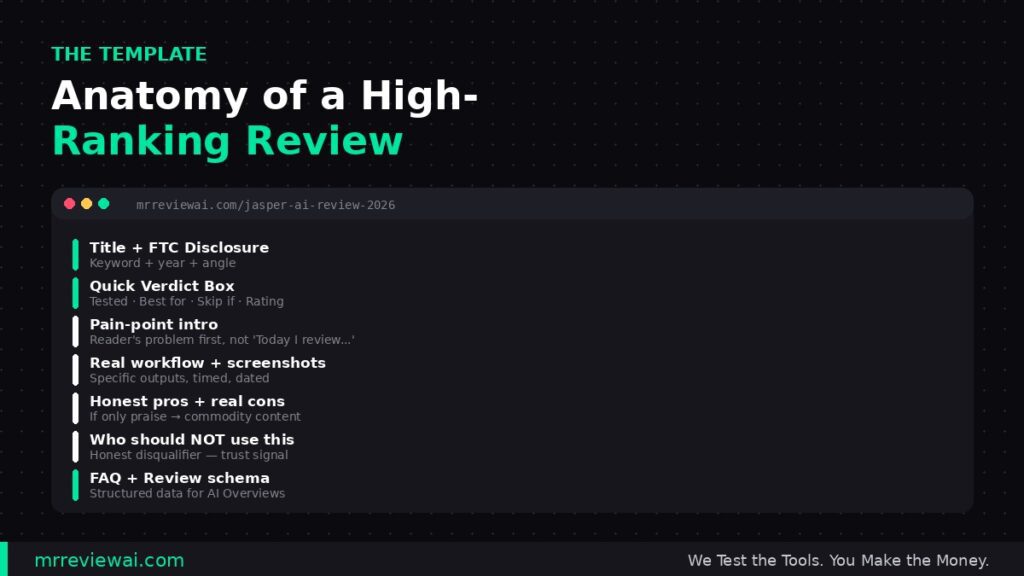
The Anatomy of a High-Ranking Review (Template)
Use this skeleton every time:
[Title — keyword + specific angle + year]
[FTC Disclosure — 1 line, italic, top of post]
[H1 — same as title or close variant]
[Intro — 100-150 words, pain point first, credibility hook second]
[Quick Verdict Box — tested, best for, skip if, one-sentence verdict]
[Table of Contents — anchor links to each H2]
[H2: What [Product] is and who it’s for]
[H2: How I actually used it — specific workflow]
[H2: What works (with outcomes)]
[H2: What doesn’t work (honest limitations)]
[H2: Pricing and ROI breakdown]
[H2: Who should NOT use this]
[H2: Best alternatives — link to comparison posts]
[H2: My verdict — rating out of 5 + final CTA]
[H2: FAQ — 5-7 questions with FAQ schema]
That’s the template. Now here’s the section that does most of the AEO work.
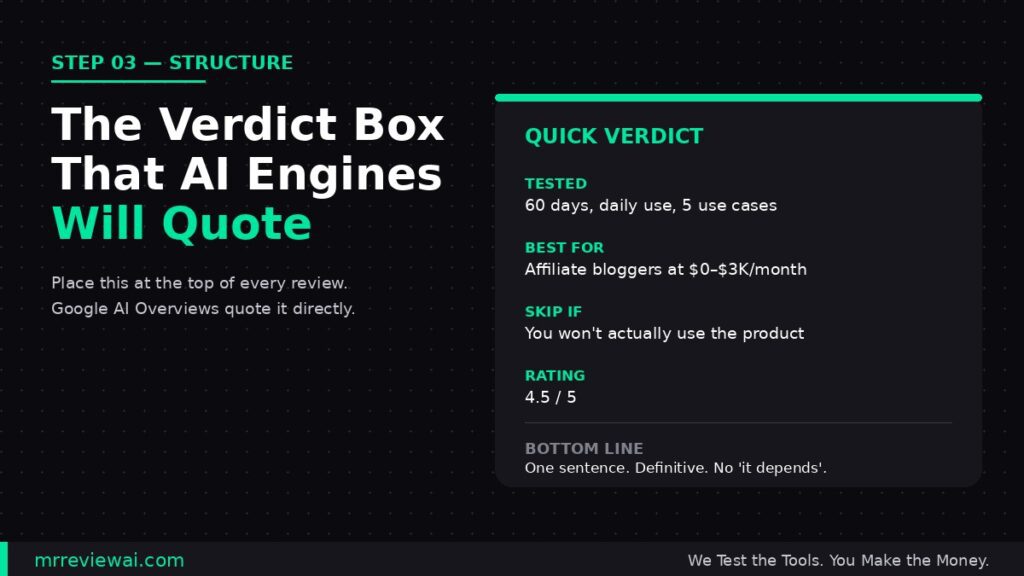
The Verdict Box That Drives Featured Snippets
The verdict box is the highest-leverage element on the page. It’s what Google’s AI Overview will quote. It’s what readers screenshot. It’s what determines whether they keep reading.
Format it as a clean, scannable block at the very top of the article (right after the intro). Include:
- Tested: How long, how many use cases
- Best for: Specific user type
- Skip if: Honest disqualifier
- Rating: X/5
- Bottom line: One sentence, definitive verdict
Avoid mushy phrases like “it depends” or “both have their strengths.” AI Overviews can’t cite ambiguity. They cite definitive statements.
Step 4 — Write Each Section With Intent-Matching Content
Each section of a review has a specific job. Match the job, hit the ranking.
Intro
Job: Hook the reader with a specific pain point. Establish credibility in 1–2 sentences. Drop the one-sentence verdict.
Skip “Today I’m reviewing…” Open with the reader’s actual problem:
“I’ve spent $340 on AI writing tools this year. Three of them I cancelled within a week. Here’s how [Tool] held up after 60 days of daily use.”
Features Section
Job: Translate features into outcomes. Not “AI-powered” — describe what the AI actually did for you.
Weak: “[Tool] uses AI to write content.” Strong: “Generated a 1,200-word draft in 4 minutes — I timed it across 8 sessions. The first draft needed about 30% editing to match my voice.”
Pros & Cons
Job: Demonstrate honest evaluation. Cons must be real. If your cons section reads like “the only con is sometimes I love it too much,” you’ve lost the trust signal Google looks for.
Who It’s For
Job: Narrow to one or two specific user types. “Anyone who wants to make money online” is not a user type. “Affiliate bloggers writing 4+ reviews per month who need consistent voice” is.
Final Verdict
Job: Definitive. Rated out of 5. With a clear CTA to the affiliate link.
Step 5 — SEO Optimization After Writing
Write first, optimize second. Optimizing while you write usually kills the voice.
After your draft is done, run through this checklist:
Primary keyword in title (front-loaded if possible)
Primary keyword in URL slug
Primary keyword in meta description with a CTA
Primary keyword appears in the first 100 words naturally
Primary keyword in at least one H2
2–3 internal links to related reviews or comparison posts
1–2 external links to authoritative sources (e.g., the product’s official docs)
Featured image with descriptive alt text
Table of contents for anything over 1,500 words
Review schema implemented (rating, reviewer, product)
FAQ schema for the FAQ section
Schema Markup
This is where most affiliate bloggers leave easy ranking points on the table.
Add Review schema to every product review. It tells Google you’ve published a structured review with a rating, reviewer name, and product name — and it makes you eligible for rich results in search.
Add FAQ schema to your FAQ section. Most SEO plugins (Rank Math, Yoast) handle this automatically if you mark up the section correctly. Validate with Google’s Rich Results Test before publishing.
AI Tools for Non-Native Writers
If English isn’t your first language, you have one extra concern: tone consistency. I’m a Vietnamese affiliate marketer writing for a US audience. I learned this the hard way.
If you want my full ranked list of every AI writing tool I’ve tested for affiliate sites, see my best AI writing tools roundup. Here’s what’s in my daily rotation:
My current stack:
- Writesonic for SEO-optimized longform drafting (~$19/mo entry plan)
- Claude AI for tone polishing and honest sections (the free tier covers most use cases)
- Surfer SEO for on-page optimization — it scores each section against the top-ranking competitors and tells me what’s missing
- Jasper AI for brand-voice consistency across 30-day publishing schedules (~$49/mo)
The free Grammarly plan handles basic copy-editing. I run every article through it as the last step before publishing.
Choosing between Jasper and Copy.ai for affiliate content? I broke down both in my Jasper vs Copy.ai comparison.
Step 6 — Publish, Update, and Watch Rankings Climb
The work isn’t done at publish.
Google’s product review system explicitly rewards updated content. Reviews that go stale lose rank. I update mine every 90 days at minimum — refreshed screenshots, updated pricing, new use cases, fresh data.
My publishing workflow:
- Schedule the post for 8:00 AM EST (when the US audience is most active)
- Distribute to Pinterest (3 pins, 3 angles) and Threads within 24 hours
- Add the post to my internal link cluster (link 2 older posts to it; update 1 older post to link back)
- Set a 90-day reminder to refresh
- Track ranking weekly in Google Search Console — if it’s stuck on page 3+ after 60 days, audit and republish
That last step is critical. A review that isn’t ranking after 60 days isn’t going to magically rank on day 100. Audit the SERP, find what the page 1 results have that yours doesn’t, and rewrite the gap.
FAQ
How long should a product review be to rank on Google?
There’s no fixed word count. The reviews ranking page 1 for my target keywords range from 1,800 to 4,500 words. What matters is whether the length is earned by actual information — first-hand usage data, screenshots, specific outcomes, honest limitations. A 2,500-word review packed with real usage data ranks better than a 5,000-word review padded with filler.
What makes a product review rank higher than competitors?
Three signals do most of the work: (1) genuine first-hand experience visible in the writing (screenshots, time-bound usage, specific outputs), (2) a definitive verdict optimized for AI Overviews, and (3) honest limitations that competitors don’t mention. Google’s 2026 product review update explicitly rewards reviewer-quality signals over keyword density.
How do I write a product review without owning the product?
Honestly, you don’t — at least not one that will rank. Google’s algorithm hunts for first-hand experience signals, and AI Overviews now cross-reference review claims. If you can’t get free trial access or buy the product, pick a different one. Affiliate income on one fake review isn’t worth the long-term authority hit.
What is the best structure for a product review?
Intro with pain point and verdict, verdict box, table of contents, what the product is and who it’s for, your actual workflow, what works (with outcomes), what doesn’t work, pricing and ROI, who should NOT use it, alternatives, final verdict with rating, FAQ. This structure matches both Google’s product review system signals and AI Overview citation patterns.
Do I need to own the product to write a review?
For a review that will rank in 2026, yes. Google’s reviewer-quality signals look for evidence of real usage — screenshots, time-bound experience, specific workflows, honest friction points. You don’t need to own it forever; a free trial or short paid subscription is enough to gather authentic usage data.
What is E-E-A-T and why does it matter for reviews?
E-E-A-T stands for Experience, Expertise, Authoritativeness, Trustworthiness — Google’s framework for evaluating content quality. For product reviews, the “Experience” signal carries the most weight. Demonstrating that you’ve actually used the product (screenshots, dated usage, specific outcomes) is the single highest-leverage thing you can do for review SEO.
How do I add affiliate links without being penalized?
Add a clear FTC disclosure at the top of every post containing affiliate links. Use natural anchor text (not “click here” or pure keyword anchors). Don’t stuff links — 3–5 affiliate links in a 2,500-word review is plenty. Mark affiliate links as rel=”sponsored” or rel=”nofollow” to comply with Google’s link attribution guidelines.
My Verdict — Writing Reviews That Rank Is a Process, Not a Hack
Rating: This process — 4.5/5
It’s not magic. It’s not a single trick. It’s six steps done consistently:
- Pick winnable keywords with hybrid intent
- Actually use the product
- Structure the review for both Google and AI Overviews
- Match content to section intent
- Optimize on-page SEO and schema after writing
- Publish, distribute, refresh
Do this for 30 reviews and you’ll have a body of work that earns rankings, not chases them. That’s how to write a product review that ranks consistently — not by chasing tricks, but by building a repeatable system.
If you want the AI tools I use in this exact workflow, the three that earned their spot in my stack are Writesonic for drafting, Surfer SEO for optimization, and Jasper AI for voice consistency. I have full reviews of each one linked throughout this site.
Next step: Read my Surfer SEO review for the on-page optimization piece, or my Writesonic review for the drafting workflow.
Have you tried this review structure on your own site? Reply on Threads @mr.reviewai and let me know what changed.
INTERNAL LINKS USED (verify before publish)
- Surfer SEO review
- Writesonic review
- Jasper AI review
- Best AI Writing Tools 2026
- Best AI SEO Tools 2026
EXTERNAL LINKS USED
- claude.ai
- Google Rich Results Test