Best Keyword Research Tools for Bloggers 2026 (Tested & Ranked)
This post contains affiliate links. I may earn a commission at no extra cost to you.
Finding the best keyword research tools for bloggers 2026 requires knowing your blog stage — most bloggers are using the wrong tool for their stage of growth.
A new blog spending $139/month on Semrush before it earns a dollar is wasting money. An established blog trying to scale on Google Autocomplete alone is leaving rankings on the table.
The right tool depends on where you are, not just what features look impressive in a demo.
I’ve used every tool on this list on real affiliate blogs — including mrreviewai.com. Here’s the honest breakdown, organized by budget and use case, so you can pick the right one for your situation today.
Table of Contents
- How to Pick the Right Keyword Tool for Your Blog Stage
- Quick Comparison Table
- Google Search Console — Best Free Tool (Non-Negotiable)
- Google Keyword Planner — Best Free Volume Data
- Ahrefs Webmaster Tools — Best Free Competitive Data
- RankIQ — Best for Blogger Niche Keywords
- Ahrefs Starter — Best Budget Paid Option
- Semrush — Best All-in-One Platform
- KWFinder — Best for Beginners Who Want Paid Data
- Ubersuggest — Best Budget Freemium Option
- AnswerThePublic — Best for Question-Based Keywords
- Google Trends — Best for Trending Topics
- FAQ
- Final Picks by Blog Stage
How to Pick the Right Tool for Your Blog Stage
Before reviewing the best keyword research tools for bloggers 2026 — here’s the filter I’d use if I were starting over:
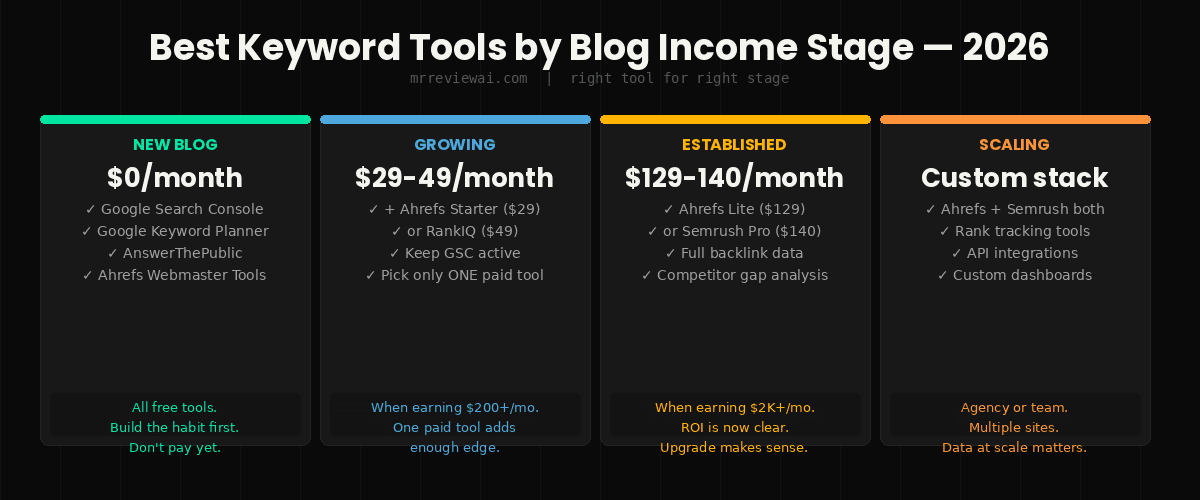
New blog (0-6 months, earning $0-500/month): Google Search Console + Google Keyword Planner + Ahrefs Webmaster Tools. All free. All you need.
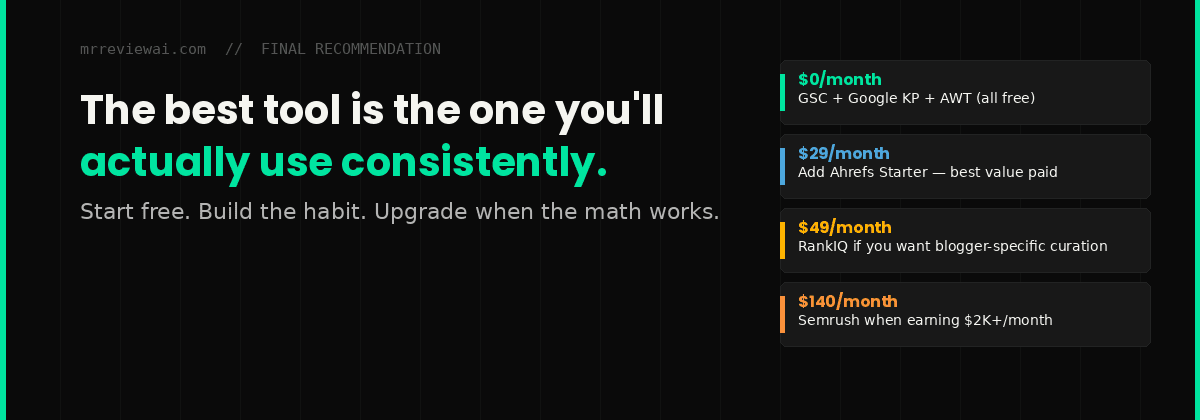
Growing blog (6-18 months, earning $500-2,000/month): Add RankIQ ($49/month) for niche keyword libraries, or Ahrefs Starter ($29/month) for competitive research. Pick one.
Established blog (18+ months, earning $2,000+/month): Ahrefs Lite ($129/month) or Semrush Pro ($139/month). Now the ROI justifies the premium data.
Spending more than your blog earns on tools is the most common early mistake. Start free, upgrade when the math works.
Best Keyword Research Tools for Bloggers 2026: Quick Comparison
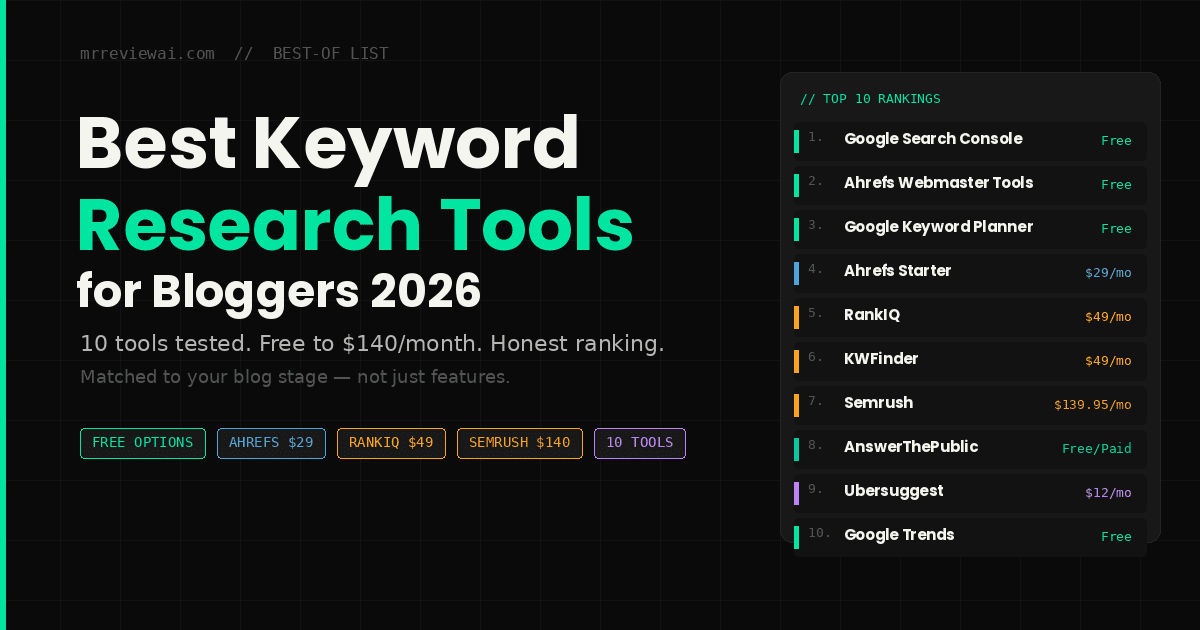
| Tool | Price | Free Plan | Best For | Blogger Rating |
|---|---|---|---|---|
| Google Search Console | Free | Yes | Rank tracking, quick wins | 5/5 |
| Google Keyword Planner | Free | Yes | Volume data, long-tail ideas | 4/5 |
| Ahrefs Webmaster Tools | Free | Yes | Site health + basic competitor data | 4.5/5 |
| RankIQ | $49/month | No | Niche keyword libraries for bloggers | 4.5/5 |
| Ahrefs Starter | $29/month | No | Competitive keyword research on a budget | 4.5/5 |
| Semrush | $139.95/month | Limited | All-in-one marketing platform | 4.3/5 |
| KWFinder | $49/month | 5 free/day | Simple, visual keyword research | 4/5 |
| Ubersuggest | Free / $12/month | Yes (limited) | Budget content marketing tool | 3.5/5 |
| AnswerThePublic | Free (3/day) | Yes | Question-based keyword discovery | 4/5 |
| Google Trends | Free | Yes | Trending topic validation | 3.5/5 |
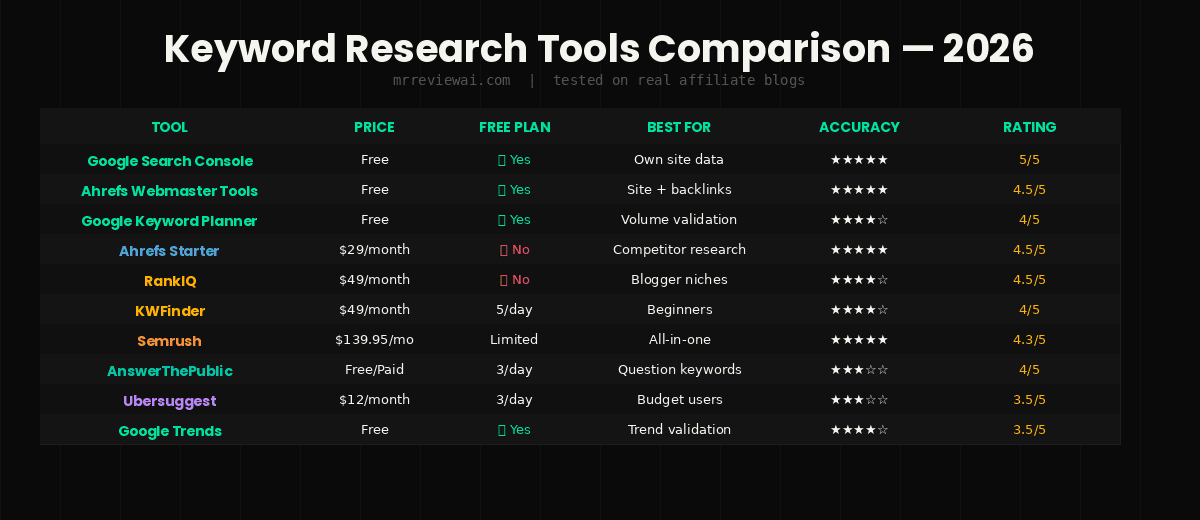
1. Google Search Console — Best Free Tool (Non-Negotiable)
Price: Free Best for: Every blogger, every stage
If you use only one tool on this list, make it Google Search Console. It’s the only tool that shows you real data about your own site directly from Google.
What GSC gives you that no paid tool can replicate: the actual queries people use to find your pages, your real click-through rates, and your actual ranking positions — not estimates. Every other tool gives you approximations. GSC gives you ground truth.
The workflow that matters most:
Every week, filter GSC for queries where your average position is between 8 and 20. These are your “quick win” pages — Google already thinks your content is relevant, but not quite good enough for page one. Update those pages with better keyword coverage, stronger FAQ sections, and more depth. Most move up 3-8 positions within 30-60 days.
This one workflow, done consistently, is worth more than any paid keyword tool.
What it doesn’t do: GSC doesn’t help you find new keywords you’re not already ranking for. For that, you need one of the tools below.
Bottom line: Install it the day you launch your blog. Request indexing for every new post. Check weekly. Non-negotiable.
👉 Start with Google Search Console — Free
2. Google Keyword Planner — Best Free Volume Data
Price: Free (requires Google Ads account — free to create) Best for: Validating search volume before writing
Google Keyword Planner is the most authoritative source of search volume data available — because it comes directly from Google. The limitations are real (volume ranges are broad, it’s designed for advertisers, not SEO), but for bloggers on a zero-dollar budget who need to validate keyword demand before committing to a 2,000-word article, it’s indispensable.
How bloggers use it effectively:
Use the “Discover new keywords” feature with a seed keyword to surface 100+ related variations. Then use “Get search volume” to validate the top candidates from your list. Cross-reference with Google Autocomplete to confirm real search behavior.
The volume ranges (“100K-1M” instead of specific numbers) are the main frustration. If you need precise volume data, you’ll need a paid tool. For directional decisions — “is anyone searching for this?” — GKP is enough.
Bottom line: Free and authoritative. Best used alongside Google Search Console as your baseline research stack before investing in paid tools.
3. Ahrefs Webmaster Tools — Best Free Competitive Data
Price: Free (for your own verified sites) Best for: Site health monitoring + basic keyword and backlink data
Ahrefs Webmaster Tools gives you access to two powerful features at zero cost: Site Audit (crawl your site for technical issues) and limited Site Explorer data (keywords ranking for your verified site and basic backlink profile).
For a new blog, this replaces several paid tools. You can see which keywords your site already ranks for, which pages have technical issues hurting your SEO, and which sites link to you — all without paying Ahrefs’ $129/month Lite plan.
What it doesn’t include: Competitor keyword research, full backlink database, or keyword difficulty scores for terms you don’t already rank for. For that, you need a paid Ahrefs plan.
The practical workflow:
After 3-4 months of publishing, use Ahrefs Webmaster Tools to find your highest-traffic pages and which keywords they’re ranking for. Then reverse-engineer why those pages are working — look at their structure, length, and keyword coverage — and replicate it in new articles.
Bottom line: The best free tool for established blogs that need competitive intelligence without a paid subscription. Should be in every blogger’s stack.
👉 [Get Ahrefs Webmaster Tools Free →] (link: ahrefs.com/webmaster-tools)
4. RankIQ — Best for Blogger Niche Keywords
Price: $49/month (no annual plan) Best for: Solo bloggers who want a curated library of low-competition keywords
RankIQ is purpose-built for bloggers — not agencies, not enterprises. The founder built it specifically for niche site owners who need low-competition keywords with real traffic potential.
The core feature is the keyword library — a curated database of keywords filtered by niche, showing competition data specifically relevant to bloggers rather than generic KD scores that treat a new blog the same as an established authority site.
What makes it different:
The Title Grader is genuinely unique. It analyzes your post title against top-ranking competitor titles and scores it for click-through rate potential. A 2-3% CTR improvement on a page getting 1,000 impressions per month is 20-30 extra clicks with zero extra work. At scale, this compounds significantly.
The Content Optimizer works similarly to Surfer SEO but is simpler — a checklist rather than a raw numbers dashboard. Better for bloggers who want clear direction over granular data.
Limitation: RankIQ doesn’t have backlink analysis, rank tracking, or site audits. It’s purely keyword research and content optimization. Use it alongside Google Search Console for a complete picture.
Bottom line: The best keyword research tool for bloggers who don’t need a full SEO platform and want low-competition keyword data without paying Ahrefs prices. At $49/month it’s more than Ahrefs Starter — but the niche-specific keyword library is a real differentiator.
5. Ahrefs Starter — Best Budget Paid Option
Price: $29/month (annual billing) Best for: Bloggers who need occasional keyword and competitor research
Ahrefs introduced the Starter plan in 2026 at $29/month — the most significant pricing change in the keyword research tool market in years. It’s a genuine entry point for bloggers who need competitive keyword data without committing to $129/month.
What the Starter plan includes:
Limited but meaningful access to Ahrefs’ Keywords Explorer (one of the most accurate keyword databases available), Site Explorer for competitor research, and basic rank tracking. The data limits mean it’s suited for occasional research rather than daily deep dives — but for a blogger publishing 10-15 articles per month, occasional research is all you need.
The accuracy advantage:
Ahrefs uses clickstream data to estimate search volume — meaning it models how people actually click through search results, not just how often a query appears. This produces more reliable volume estimates than tools that rely purely on Google Ads data. For affiliate bloggers making content decisions based on keyword potential, accuracy matters more than database size.
Bottom line: At $29/month, Ahrefs Starter is the best value paid keyword research option in 2026. Start here before considering any higher-tier plan.
6. Semrush — Best All-in-One Platform
Price: $139.95/month (Pro), 14-day free trial Best for: Established blogs and teams needing SEO + content + PPC in one platform
Semrush’s Keyword Magic Tool accesses a database of over 25 billion keywords — the largest available. The AI-powered Personal Keyword Difficulty (PKD%) score shows competition levels customized to your specific domain, not generic scores. The Keyword Gap tool is the best competitive keyword analysis feature in the industry.
Who should pay $139.95/month for this:
Teams running SEO alongside PPC campaigns. Agencies managing multiple client sites. Established blogs with $2,000+/month in revenue where the keyword data advantages translate to measurable ranking improvements. The 2026 addition of AI search visibility tracking (monitoring your brand in ChatGPT and Perplexity) adds value for brands concerned with AI search presence.
Who should not pay $139.95/month:
New bloggers. Solo creators earning under $1,000/month. Anyone who only needs keyword research and not the broader marketing platform features. For pure keyword research at a lower price, Ahrefs Starter at $29/month or RankIQ at $49/month are better value.
Bottom line: The most comprehensive tool on this list — but only justifiable when your blog’s revenue and scale make the investment rational.
7. KWFinder — Best for Beginners Who Want Paid Data
Price: $49/month (Basic), $69/month (Premium) Best for: Beginners who want clean, visual keyword data without complexity
KWFinder from Mangools strips keyword research to its essentials: search volume, keyword difficulty, long-tail suggestions, and SERP analysis — presented in a clean, color-coded interface that beginners find immediately usable.
The KD (keyword difficulty) scoring uses a 0-100 scale with color coding — green is achievable, red is competitive — which makes keyword selection decisions faster for users who don’t want to interpret raw numbers.
SERPChecker (included in Mangools suite) evaluates ranking difficulty by analyzing the top pages for any keyword, showing their domain authority, backlinks, and content metrics. For a new blogger trying to understand whether a keyword is winnable, this analysis is more useful than a raw KD number.
Limitation: Daily search quotas on lower plans feel restrictive for intensive research sessions. If you’re doing bulk keyword research for a 30-day content calendar, you’ll hit the limit faster than you’d like.
Bottom line: A solid, beginner-friendly tool at a mid-tier price. Competes with Ahrefs Starter at $29/month — the Ahrefs brand and data reputation give Ahrefs the edge, but KWFinder’s interface is genuinely easier for SEO newcomers.
8. Ubersuggest — Best Budget Freemium Option
Price: Free (3 searches/day), Premium from $12/month Best for: Budget-conscious bloggers who need basic keyword ideas
Ubersuggest by Neil Patel offers 3 free keyword searches per day — enough for occasional research without a subscription. The premium plan at $12/month (billed annually) is the lowest price point for any meaningful keyword research capability in 2026.
What works well:
The Content Ideas feature extracts real-world content performance data — showing which articles in your niche get the most backlinks and social shares. This helps you understand what kind of content resonates in your niche beyond just search volume.
The Traffic Analyzer shows competitor top pages and the keywords driving their traffic — useful for reverse-engineering successful affiliate blogs in your niche.
What doesn’t work as well:
Keyword difficulty scores have historically been less accurate than Ahrefs or Semrush. Volume data is approximate. The interface is functional but can feel busy. For serious keyword research decisions, you’d want to cross-reference Ubersuggest data against Google Search Console actuals.
Bottom line: Worth using on the free tier for supplementary research. The $12/month premium is accessible, but Ahrefs Starter at $29/month gives you significantly better data for a bit more. Best for bloggers who are genuinely budget-constrained.
9. AnswerThePublic — Best for Question-Based Keywords
Price: Free (3 searches/day), paid plans from $50/lifetime Best for: Finding question-based keywords for FAQ sections and featured snippets
AnswerThePublic visualizes all the questions people ask around a seed keyword — organized by who, what, when, where, why, and how. For bloggers building FAQ sections and targeting People Also Ask boxes in Google, this is the fastest way to find the exact phrasing searchers use.
The visual “wheel” format makes it immediately obvious which questions have the most coverage (and which are underserved). Underserved questions are your opportunity.
Practical use case for affiliate bloggers:
After writing a review post, run your tool name through AnswerThePublic. Every question in the results that’s relevant to your article should be answered in your FAQ section. This directly increases your chances of appearing in People Also Ask boxes — free clicks from high-intent searchers.
Limitation: No search volume data. You get question ideas, not demand validation. Use alongside Google Keyword Planner to verify whether the questions have real search volume.
Bottom line: Free tier covers most bloggers’ needs. Best used for FAQ research alongside a primary keyword tool, not as a standalone research platform.
10. Google Trends — Best for Trending Topics
Price: Free Best for: Validating keyword seasonality before committing to an article
Google Trends shows how search interest for a keyword changes over time and across regions. Essential for avoiding a common affiliate blogger mistake: writing a definitive review for a tool that’s declining in popularity.
How to use it:
Before writing a review, search the tool name in Google Trends. Is interest growing, stable, or declining? A tool with rising search interest is a better bet than one losing attention to competitors.
Compare two keywords to see which has stronger momentum — useful for deciding which comparison post to write next.
The “Related Topics” and “Related Queries” sections surface adjacent keywords trending alongside your target — potential angles for follow-up articles.
Limitation: No absolute search volume numbers (only relative interest 0-100). Not useful for keyword difficulty assessment. Best used for directional validation alongside a tool that shows actual volume data.
Bottom line: Free and unique — no other tool shows keyword momentum over time as clearly. Add it to your research stack for trend validation.
11. Frase.io — Best for AI-Powered SERP Research & Content Briefs
One-line verdict: Frase turns keyword research into a complete content brief in under 5 minutes — automatically pulling what the top 20 results cover.
Best for: Bloggers who want to research AND write SEO content in the same workflow.
Pricing: Starts at $44.99/month
What it does:
Frase.io does something no other keyword research tool on this list does: it bridges the gap between keyword research and content creation. Type in a keyword, and Frase instantly scrapes the top 20 Google results — showing you the headings, questions, and topics every ranking article covers. Then it gives you an AI writing assistant to help you write the post that beats them all.
For bloggers publishing affiliate content at volume, Frase is arguably more useful than a pure keyword research tool. You’re not just finding keywords — you’re getting a blueprint for what to write to rank for them.
FAQ
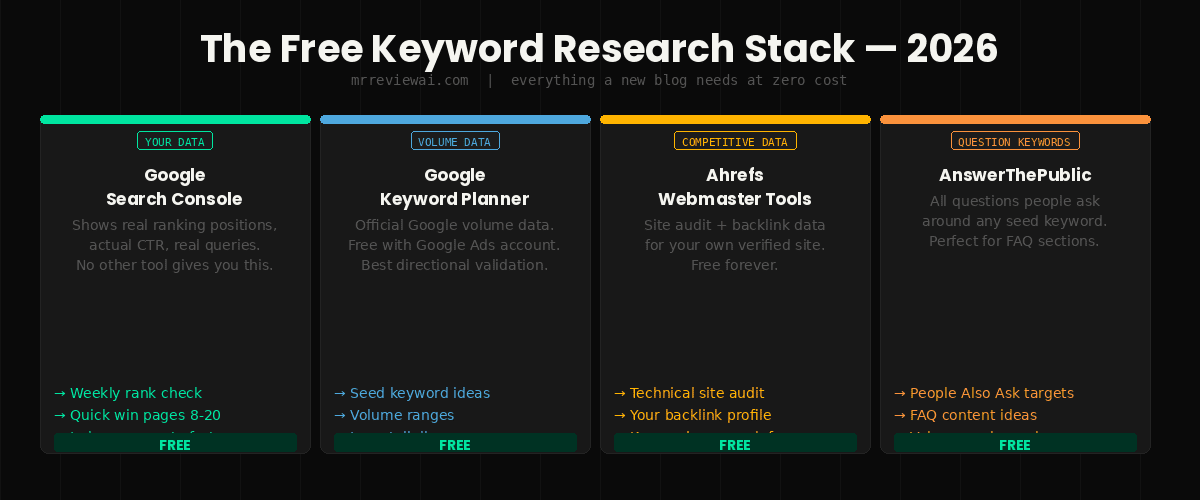
What is the best free keyword research tool for bloggers in 2026? Google Search Console is the most valuable free tool — it shows your actual ranking data directly from Google. For finding new keywords, pair it with Google Keyword Planner and Ahrefs Webmaster Tools. Together, these three free tools cover the essential keyword research needs of any blog in its first 12 months.
Is Semrush worth it for bloggers? At $139.95/month, Semrush is only worth it for bloggers whose sites generate significant revenue and who actively use the content marketing, PPC research, and competitor analysis features. For pure keyword research, Ahrefs Starter at $29/month or RankIQ at $49/month give better value for solo bloggers. See our full Ahrefs vs Semrush comparison for a detailed breakdown.
What keyword research tool is best for a new blog with no budget? Google Search Console + Google Keyword Planner + AnswerThePublic covers the fundamentals at zero cost. Add Ahrefs Webmaster Tools (free) once you have content indexed and want to analyze what’s working.
How accurate are keyword volume estimates from free tools? Variable. Google Keyword Planner shows volume ranges (not precise numbers) that are directionally accurate. Ahrefs Webmaster Tools shows precise volume data but only for keywords your own site ranks for. For precise volume on new keywords, you need a paid tool. Ahrefs Starter at $29/month is the most accurate entry-level paid option.
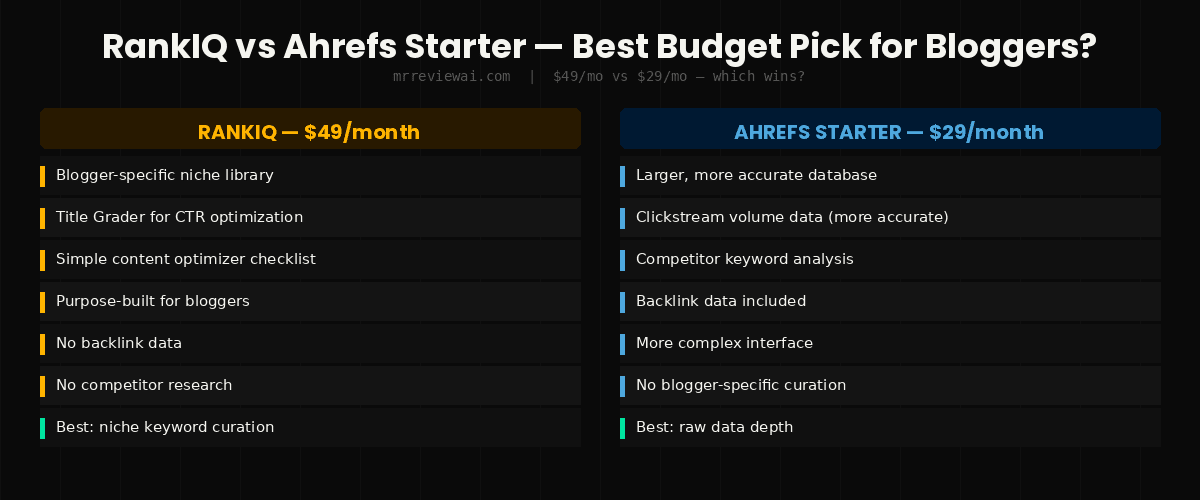
RankIQ vs Ahrefs — which is better for bloggers? RankIQ is purpose-built for bloggers with niche-specific keyword libraries and a simpler interface. Ahrefs is a broader SEO platform with more comprehensive data and a lower entry price ($29/month vs $49/month). RankIQ wins if you want blogger-specific keyword curation. Ahrefs wins if you want raw data depth and competitive research capability.
Final Picks by Blog Stage
Starting out ($0/month): Google Search Console + Google Keyword Planner + AnswerThePublic
First 6 months ($0/month): Add Ahrefs Webmaster Tools — covers site health and basic competitive data for free
Earning $200-500/month ($29/month): Add Ahrefs Starter — best value paid entry point in 2026
Earning $500-2,000/month ($49/month): Ahrefs Starter or RankIQ — choose based on whether you want data depth (Ahrefs) or blogger-specific curation (RankIQ)
Earning $2,000+/month ($129-140/month): Ahrefs Lite or Semrush Pro — now the ROI is clear and the data advantages matter
The best keyword research tool is the one you’ll actually use consistently. Start simple. Build the research habit. Upgrade when your blog’s income makes the investment logical.
👉 Start with Google Search Console — Free 👉 Try Ahrefs Webmaster Tools Free 👉 Try RankIQ
Looking to combine these keyword tools with AI? Read our complete guide: How to Do Keyword Research with AI Tools. For a broader toolkit overview, see the best AI SEO tools for bloggers in 2026. Content optimization tools like Surfer SEO and Scalenut pair well with keyword research tools.
Published by mrreviewai.com | Last updated: May 2026 All tools tested across mrreviewai.com and multiple affiliate sites.
Frequently Asked Questions About Keyword Research Tools
What is the best free keyword research tool for new bloggers?
Google Search Console is the best free tool once your site has real traffic. Before that, I used Ubersuggest and Google Keyword Planner to find my first keywords. Both are free and good enough for your first 20 to 30 posts before you start spending money on paid tools.
Do I really need Ahrefs or Semrush as a beginner blogger?
No, not yet. Start free, learn what keyword difficulty and search volume mean, publish your first 20 articles, then upgrade. I waited four months before paying for any keyword tool. Most paid tools make more sense once you have some data from Search Console to work with.
How do I find keywords I can actually rank for on a new site?
Filter for keywords with difficulty under 20 and monthly volume between 100 and 1,000. These are the “easy win” keywords that new sites can realistically rank for. I built my first 30 posts entirely around keywords in this range and started seeing Google traffic within three months.
What is the difference between Ahrefs and Semrush in plain language?
Ahrefs is better if backlinks and competitor analysis are your main focus. Semrush is better if you want one tool that covers SEO, PPC, social, and content marketing in one dashboard. For pure affiliate blogging, I lean toward Ahrefs for the keyword and backlink data.
Which keyword tool gives the most accurate search volume data?
No tool is perfectly accurate. They all estimate. Ahrefs and Semrush are generally considered the most reliable. Google Keyword Planner shows ranges rather than exact numbers, which is less useful when you are trying to decide whether a specific keyword is worth targeting.
🎁 Free Weekly AI Tool Picks
Join 1,000+ bloggers getting tested AI tool recommendations every week. No spam, unsubscribe anytime.