Claude AI vs ChatGPT 2026: Which Is Better for Bloggers?
Disclosure: This post contains affiliate links. If you purchase through them, I may earn a commission at no extra cost to you. I only recommend tools I’ve actually tested.
Wondering about Claude AI vs ChatGPT for bloggers in 2026? For two years, the answer to “which AI should I use for blogging?” was ChatGPT. It wasn’t even close — it was the default, the Kleenex of AI writing tools.
Something changed in 2026.
Claude jumped from #131 on the Apple App Store to the number one spot in February 2026, overtaking ChatGPT for the first time. Daily active users hit 11.3 million. Developers report that 70% now prefer Claude for complex tasks. And most relevantly for bloggers: writing professionals consistently describe Claude’s prose as more natural, more direct, and significantly less “AI-sounding” than ChatGPT’s output.
This Claude AI vs ChatGPT 2026 comparison is based on 12 months of daily use across both platforms — blog posts, SEO content, research, affiliate reviews, and email newsletters. Here’s the honest breakdown.
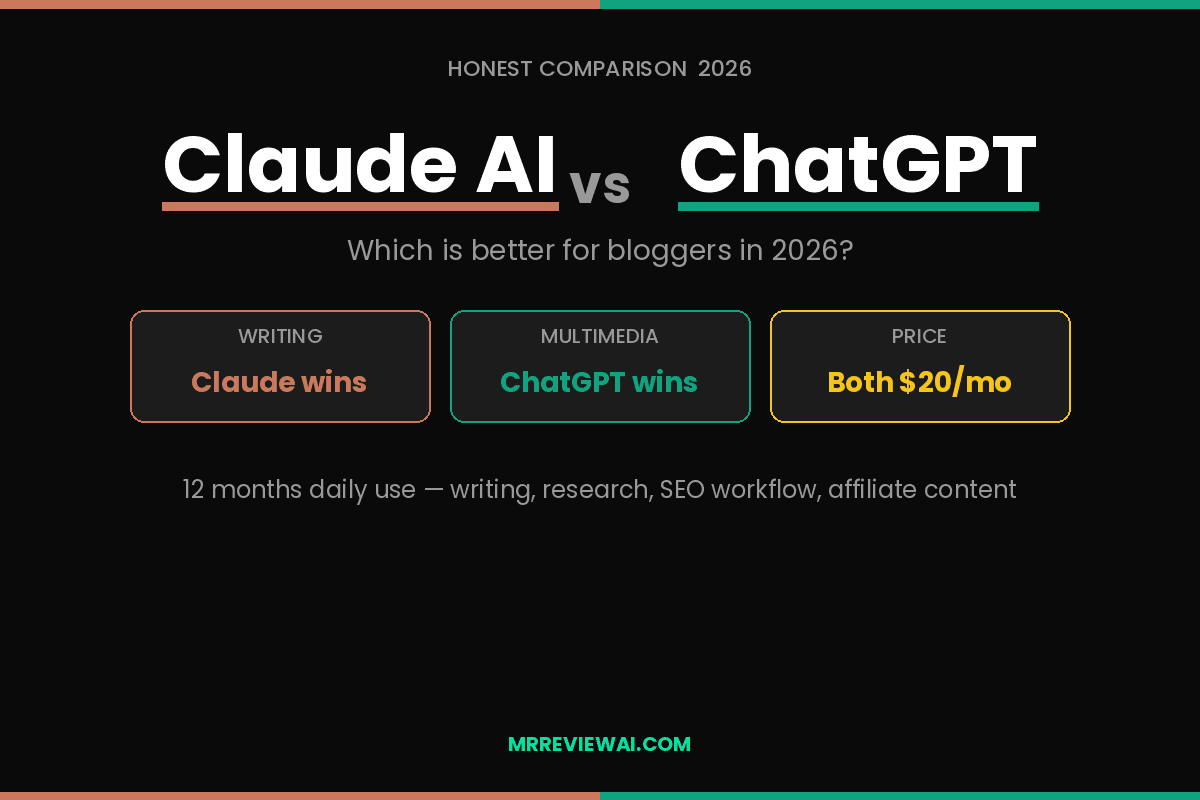
Short answer for the Claude AI vs ChatGPT 2026 debate: Claude wins on writing quality. ChatGPT wins on multimedia breadth. The right choice depends entirely on what you actually do.
Quick Comparison: Claude AI vs ChatGPT 2026
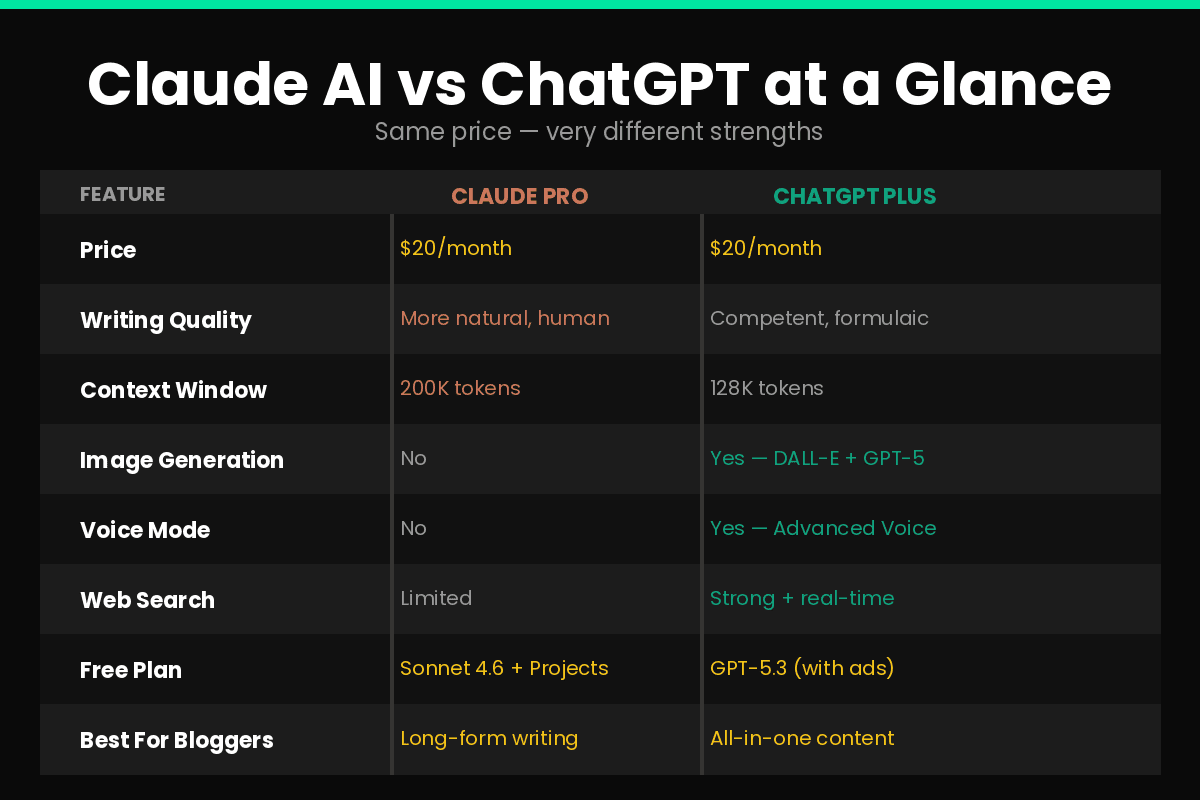
| Claude Pro | ChatGPT Plus | |
|---|---|---|
| Price | $20/month | $20/month |
| Best for | Long-form writing, depth, reasoning | Multimedia, ecosystem, versatility |
| Writing quality | ★★★★★ More natural, less AI-sounding | ★★★★☆ Competent, formulaic |
| Context window | 200,000 tokens | 128,000 tokens |
| Image generation | No | Yes (DALL-E + GPT-5) |
| Voice mode | No | Yes (Advanced Voice) |
| Web search | Yes (limited) | Yes (strong) |
| Free plan | Yes — Sonnet 4.6 | Yes — GPT-5.3 (with ads) |
| My pick for bloggers | Writing-heavy workflows | All-in-one multimedia content |
Table of Contents
- The Core Difference
- Writing Quality: The Test That Matters Most
- Pricing 2026
- Context Window — Why It Matters for Bloggers
- Research and Web Browsing
- Workflow for Bloggers Specifically
- Where ChatGPT Clearly Wins
- Where Claude Clearly Wins
- Who Should NOT Use Each
- Final Verdict
- FAQ
The Core Difference
Before comparing features, the philosophy difference defines every output:
Claude was built with a focus on being helpful, harmless, and honest. It pushes back when something doesn’t make sense, offers alternatives, and produces writing that sounds less like a template. Claude is optimized for depth and precision on knowledge work — long-form writing, complex reasoning, nuanced analysis.
ChatGPT was built for versatility and accessibility across every modality. It doesn’t just generate text — it generates images with DALL-E, interprets voice, browses the internet, executes code in a sandbox, and connects with thousands of specialized GPTs. ChatGPT is optimized for breadth: more features, more integrations, more accessible to non-technical users.
For bloggers in this Claude AI vs ChatGPT 2026 comparison: if your primary need is writing better, longer, more natural-sounding content — Claude is built for you. If your primary need is an all-in-one toolkit that handles writing, image creation, voice, and visual content — ChatGPT is the better single subscription.
Writing Quality: The Test That Matters Most
This is the category that matters most for bloggers, and it has the clearest data.
There is a recognizable pattern to AI-generated text — the “In a dynamic business environment” openers, the “It’s important to note that” filler phrases, the way everything sounds like a well-meaning college student padding a word count. In the industry, it’s called AI slop, and ChatGPT produces more of it.
Claude’s writing feels different. Tom’s Guide’s 2026 “AI Madness” tournament, which ran seven real-world benchmarks head-to-head, found a growing “sophistication gap”: where ChatGPT used generic frameworks and academic templates, Claude had what they described as a “lived-in quality” that felt less robotic.
In practical terms for bloggers:
Claude produces more natural prose. Sentence length varies. Paragraph transitions flow. Tone matching is more accurate when you provide examples of your voice. The consensus among professional writers is consistent: Claude’s output reads as more human-like, while ChatGPT tends toward a formulaic style that is competent but recognizable.
In this Claude AI vs ChatGPT 2026 writing test, for a personal brand blog where voice matters — affiliate reviews, opinion pieces, reader guides — most writers prefer Claude. For scaled content where consistency matters more than personality — product descriptions, FAQ sections, templated emails — ChatGPT is faster and less likely to introduce stylistic variation.
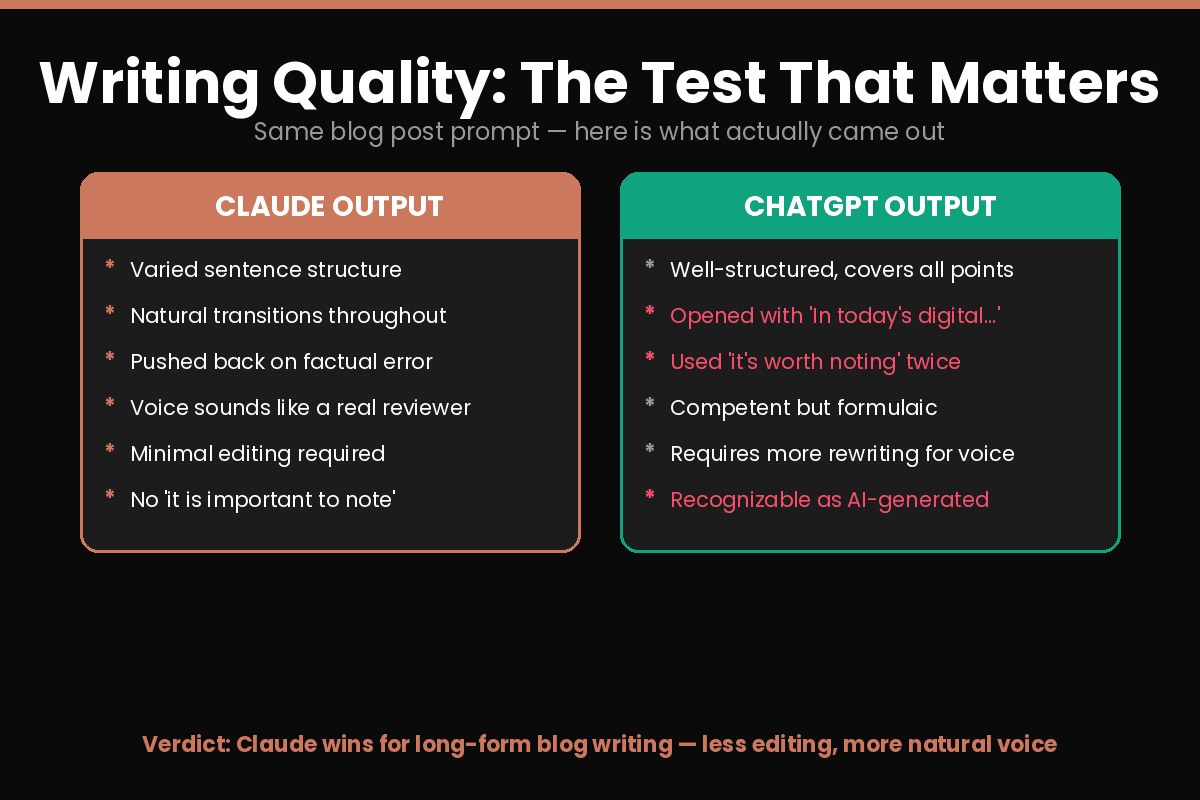
Blog post test (same 1,500-word review prompt):
Claude’s output: Varied sentence structure, natural transitions, pushed back on one prompt element that was factually off, delivered a voice that sounded like a person who’d used the product. Required minimal editing.
ChatGPT’s output: Well-structured, covered all points, used “it’s worth noting” twice and opened with “In today’s digital landscape.” Competent but identifiable as AI. Required more rewriting for voice.
Winner for long-form blog writing: Claude — clearly.
Pricing 2026
Both tools are priced identically at the consumer tier — a pricing convergence that is almost certainly not coincidental.
Claude Pricing 2026
- Free: Sonnet 4.6, Projects, basic tools — genuinely useful for light use
- Pro: $20/month — full model access, higher limits, Claude Code
- Max: $100–200/month — Opus 4.6, highest context and rate limits
- Team: $30/person/month — collaboration features
ChatGPT Pricing 2026
- Free: GPT-5.3 with ads (added February 2026), usage caps
- Go: $8/month — more messages, no ads, limited advanced features
- Plus: $20/month — GPT-5.4, DALL-E images, Sora video, Voice Mode, web browsing
- Pro: $100/month — extended limits (launched April 2026, response to Claude Max)
The honest pricing reality:
At $20/month, both Pro and Plus deliver comparable writing capability. The decision comes down to what else you need from the subscription.
ChatGPT Plus bundles significantly more features at $20: image generation with DALL-E, short video with Sora, real-time voice mode, and web browsing. For bloggers who also need visual content in their workflow, ChatGPT Plus delivers more per dollar.
Claude Pro delivers better writing quality and a 200,000-token context window — but no images, no voice, and limited visual generation. For writing-heavy bloggers, the lack of multimedia is a real gap.
Both tools have free tiers that are now genuinely useful. Claude’s free tier opens up Sonnet 4.6 and Projects. ChatGPT’s free tier offers GPT-5.3 with ads. The gap between free and paid has never been smaller.
Context Window — Why It Matters for Bloggers
A context window is essentially the AI’s short-term memory — how much text it can hold before it starts losing track of what was said earlier.
Claude handles 200,000 tokens — roughly equivalent to an entire novel, or about 500 pages. ChatGPT Plus offers 128,000 tokens.
For a typical 1,500-word blog post, neither limit matters. But for bloggers who work with longer documents, this gap becomes meaningful:
Where Claude’s 200K context changes the workflow:
Pasting an entire ebook or course curriculum to generate derived blog content. Uploading full competitor research to inform a comprehensive review. Maintaining consistent voice across a 10,000-word pillar post without the AI “forgetting” the tone established at the beginning. Analyzing an entire year of blog analytics to identify content strategy improvements.
Ever tried to upload a 90-minute Zoom transcript to an AI and watch it forget what happened at minute 20? Claude’s 200K context solves this. ChatGPT’s 128K context is still large — but in extended conversations with heavy context, Claude holds the thread more reliably.
Winner for long-document workflows: Claude.
Research and Web Browsing
ChatGPT wins on research depth and web integration.
ChatGPT’s web browsing integrates real-time search more deeply into the writing workflow. The combination of current web access, GPT Store research tools, and Perplexity-style citation is genuinely useful for fact-checking, pulling current statistics, and researching topics that require up-to-date data.
Claude’s web search is more limited — available but not as deeply integrated. For bloggers who rely heavily on current data, statistics, and recent news for their content, ChatGPT’s research workflow is more polished.
Winner for research and current information: ChatGPT.
Workflow for Bloggers Specifically
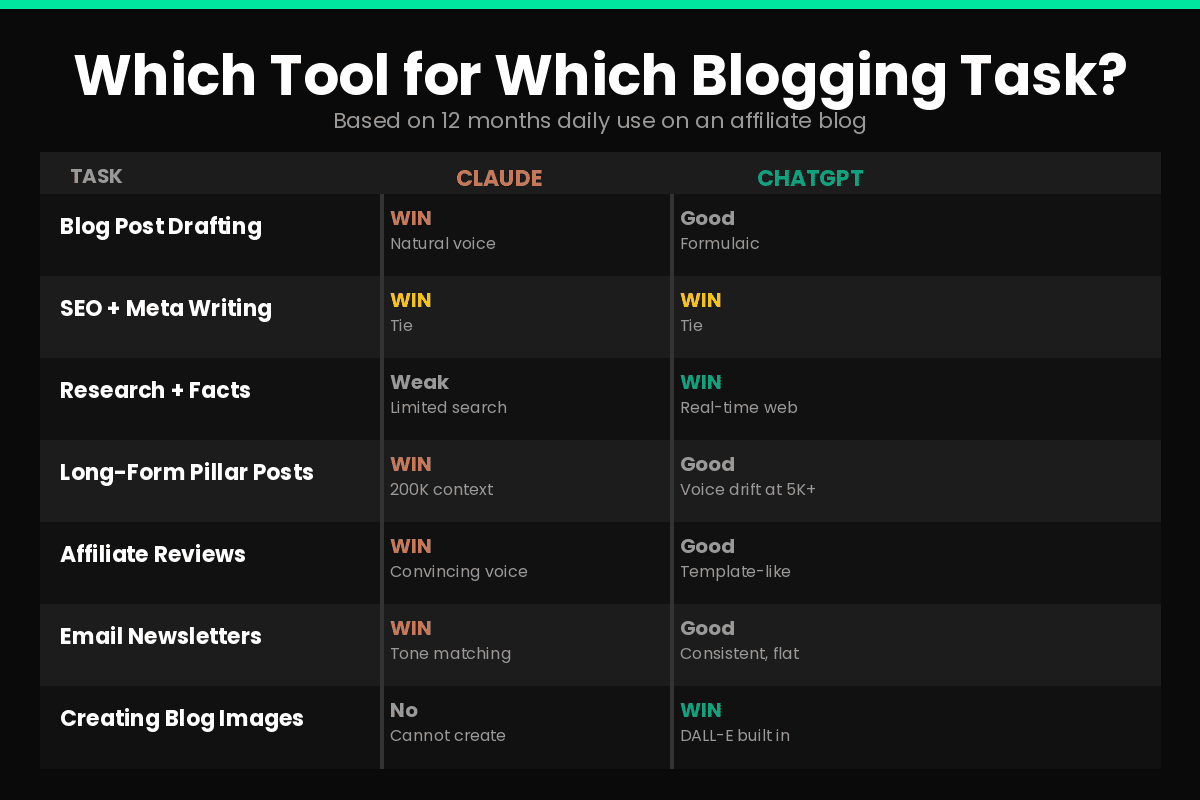
Here’s how each tool maps to the actual tasks affiliate bloggers perform in the Claude AI vs ChatGPT 2026 workflow:
Blog post drafting (hero content, reviews, guides): Claude. The natural writing voice reduces editing time significantly. For a blogger publishing 3+ posts per week, the reduced post-processing time adds up.
SEO title and meta description generation: Tie — both handle this well. ChatGPT’s structured output style works slightly better for short, optimized copy.
Research and fact-gathering: ChatGPT. Better web integration and current data access.
Long-form pillar content (5,000+ words): Claude. The 200K context window maintains consistency across the full article length. ChatGPT can struggle with voice consistency in very long documents.
Affiliate product review writing: Claude. More natural “I tested this” voice, less formulaic. Reviewers consistently describe Claude-generated product reviews as more convincing and less AI-detectable.
Email newsletter drafting: Claude. Tone matching and natural sentence variation make newsletters sound more personal.
Social media captions and short-form content: Tie — both handle short-form well. ChatGPT’s ecosystem includes social media-specific GPTs.
Creating images for blog posts: ChatGPT only. Claude cannot generate images. You need a separate tool (Midjourney, DALL-E, Canva) when using Claude.
Where ChatGPT Clearly Wins
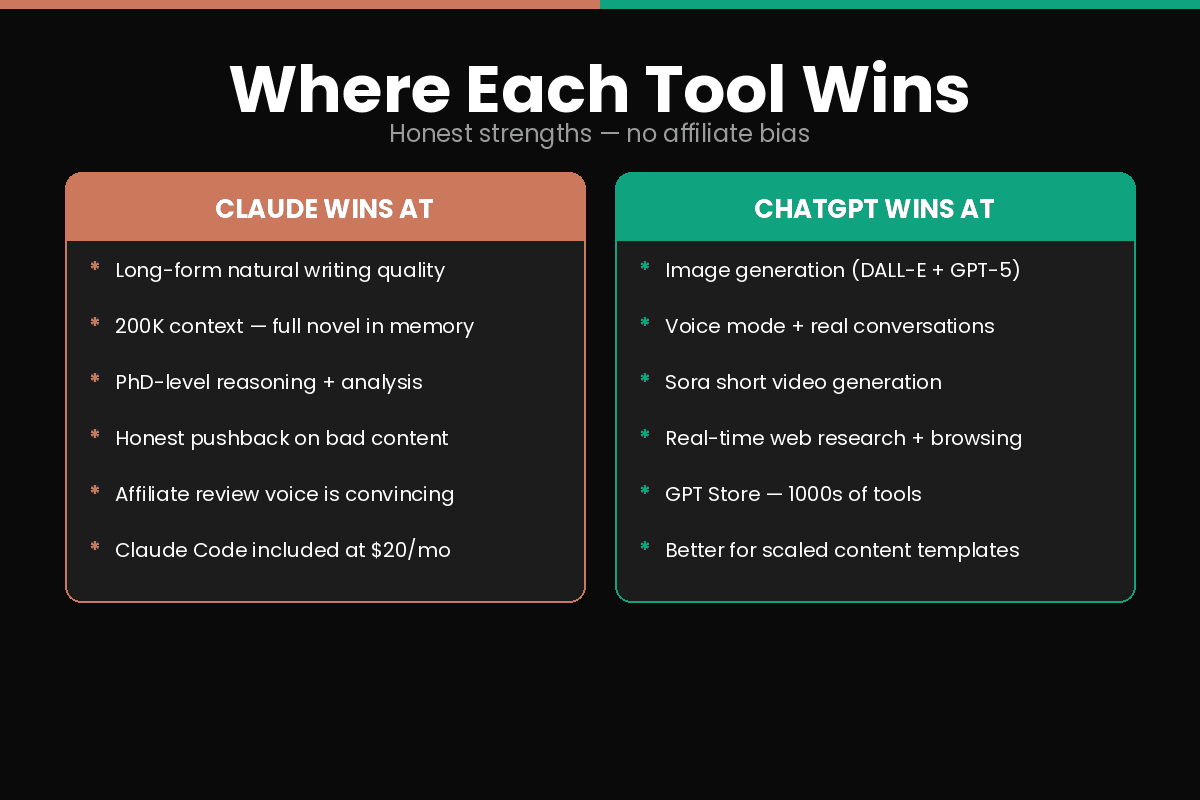
Image generation. ChatGPT Plus includes DALL-E and GPT-5’s built-in image generation. Claude cannot create images at all. For bloggers who need featured images, social media graphics, or illustrations integrated into their writing workflow, ChatGPT is the only option of the two.
Voice mode. Advanced Voice Mode allows real-time voice conversations with ChatGPT. For bloggers who want to dictate content ideas, have conversations with AI to brainstorm, or use voice for accessibility — ChatGPT is the clear choice.
Ecosystem and integrations. The GPT Store has thousands of specialized tools. Zapier integration. Microsoft Office integration. Browser extension for web research. Claude’s ecosystem is significantly smaller.
Web browsing depth. ChatGPT’s integration with real-time web data is more mature and deeply embedded in the writing workflow.
Sora video. ChatGPT Plus includes access to Sora for short video generation — relevant for bloggers who also create YouTube content.
Where Claude Clearly Wins
In the Claude AI vs ChatGPT 2026 face-off, Claude excels in these areas. Writing quality for long-form content. The “lived-in quality” observed in Tom’s Guide’s 2026 benchmarks is real and consistent. Claude’s prose is more natural, more varied in structure, and requires less editing to sound human.
Context window. 200K tokens vs 128K. For bloggers working with long-form content and large document analysis, this difference is material.
Reasoning and analysis depth. Claude leads on GPQA Diamond (PhD-level reasoning) with 91.3% vs ChatGPT’s benchmark. For bloggers who write analytical content, comparison posts, or research-heavy guides, Claude’s depth of reasoning produces better output.
Honesty and pushback. Claude pushes back on factually questionable content and offers alternatives. ChatGPT is more obedient — it produces what you ask even when what you ask is flawed. For bloggers who want a thinking partner rather than an execution tool, Claude’s willingness to challenge is valuable.
Claude Code. Included in Pro at $20/month — a terminal-based coding agent that 70% of developers prefer. Irrelevant for most bloggers, transformative for bloggers who also build or maintain their own tools.
Who Should NOT Use Each
Don’t use Claude if:
- You need image generation in your content workflow — Claude cannot create images
- Voice interaction is part of your workflow — Claude has no voice mode
- You rely on a broad ecosystem of specialized tools — ChatGPT’s GPT Store has no equivalent
- Your blog content is heavily image-dependent (photography, design, visual-first)
Don’t use ChatGPT Plus if:
- Long-form, natural-sounding prose is your primary need — Claude wins on voice quality
- You work with long documents consistently — Claude’s 200K context handles them better
- You want an AI that challenges your thinking rather than executes requests without question
- You’re primarily a writer, not a multimedia creator
Final Verdict
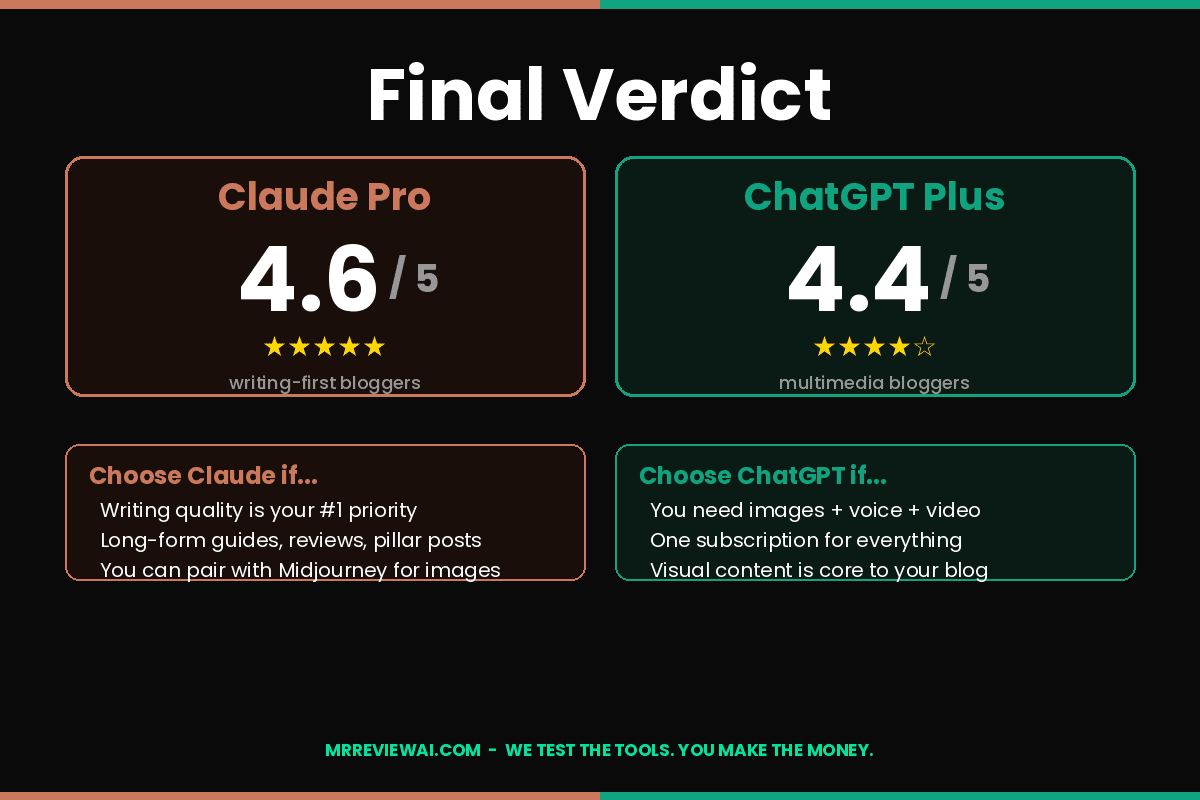
For writing-first bloggers: Claude Pro at $20/month wins.
In this Claude AI vs ChatGPT 2026 test, if your blog is text-heavy — affiliate reviews, how-to guides, opinion content, pillar posts — Claude’s natural writing voice, superior context window, and analytical depth make it the better tool for the actual words on the page. The lack of image generation is a real limitation, but it’s solvable with a separate tool (Canva, Midjourney, or the free tier of DALL-E).
For multimedia bloggers and content creators: ChatGPT Plus at $20/month wins.
If you need a single subscription that handles writing, image creation, video snippets, voice interaction, and research in one interface — ChatGPT Plus bundles more capability per dollar. The writing quality gap vs Claude is real but manageable with better prompting.
The power user recommendation: Use both. At $40/month total, you get the best writing AI (Claude) and the best multimedia AI (ChatGPT). Route each task to the tool that handles it best: Claude for drafting and long-form content, ChatGPT for images, research, and multimedia.
The honest one-sentence verdict for Claude AI vs ChatGPT 2026: Claude writes better. ChatGPT does more. Which matters more depends on what kind of blogger you are.
Try Claude Free → | Try ChatGPT Free →
This Claude AI vs ChatGPT 2026 comparison covers the tools I’ve tested most extensively. For the full AI writing tool landscape, see Best AI Writing Tools for Bloggers 2026. And for building your complete content creation stack, see Best SaaS Tools for Solopreneurs 2026.
FAQ
Is Claude better than ChatGPT for blogging in 2026?
For writing quality specifically — yes. Claude produces more natural, less formulaic prose with better long-document consistency. For all-around blogging workflow including image creation, research, and multimedia — ChatGPT Plus offers more features at the same $20/month price. The right choice depends on whether writing quality or feature breadth matters more to your workflow.
How much does Claude AI cost in 2026?
Claude has a free tier with Sonnet 4.6 access. Claude Pro costs $20/month with full model access and higher limits. Claude Max costs $100–200/month for Opus 4.6 access and highest rate limits. Claude Team is $30/person/month for collaborative workspaces.
Can Claude AI generate images?
No. As of May 2026, Claude cannot generate images, video, or audio. It can analyze images you upload, but it cannot create visual content. For image generation, you need a separate tool — Midjourney, DALL-E via ChatGPT, or Adobe Firefly.
Which AI is better for affiliate blog writing?
In any Claude AI vs ChatGPT 2026 review workflow, Claude produces more convincing affiliate review writing — the natural voice and “I tested this” tone is more effective for review content than ChatGPT’s more formulaic output. For purely SEO-structured content like product roundups and comparison tables, both tools perform similarly.
Is Claude AI free?
Yes. When considering Claude AI vs ChatGPT 2026 pricing, Claude has a genuinely useful free tier with access to Sonnet 4.6 and Projects. The free tier is sufficient for light blogging use. Claude Pro at $20/month unlocks higher limits and full model access for regular content creators.
If you’ve already decided Claude is your tool and you’re wondering whether the Max plan is worth the upgrade, I’ve written a detailed breakdown of my daily workflow: I Pay $100/Month for Claude Max — Here’s What My Day Actually Looks Like.
For more AI writing tool comparisons on MrReviewAI.com, check our Jasper AI review and best SaaS tools guide. This Claude AI vs ChatGPT 2026 comparison will be updated as new models release.
Last updated: May 2026. Pricing and features verified as of publication date.