How to Build an Affiliate Blog That Sells for $1M
Disclosure: This post contains affiliate links. If you purchase through them, I may earn a commission at no extra cost to you. I only recommend tools I’ve actually tested.
If you want to know how to build affiliate blog revenue worth $1 million, you are not alone. Most bloggers want to build an affiliate blog that sells for $1 million. Few actually do — because almost everyone focuses on traffic while ignoring exit value. The key is treating your content site as a business from the first post.
That’s the difference between building a blog that earns a few thousand dollars a month — and building an affiliate blog that sells for seven figures at exit.
A $1 million affiliate blog exit is not a fantasy. In late 2024, a Shopify store selling spiritual jewelry sold for $12 million through Empire Flippers. Content sites routinely sell for six and seven figures on the same platform every month. During 2020 to early 2023, Empire Flippers was selling million-dollar businesses weekly.
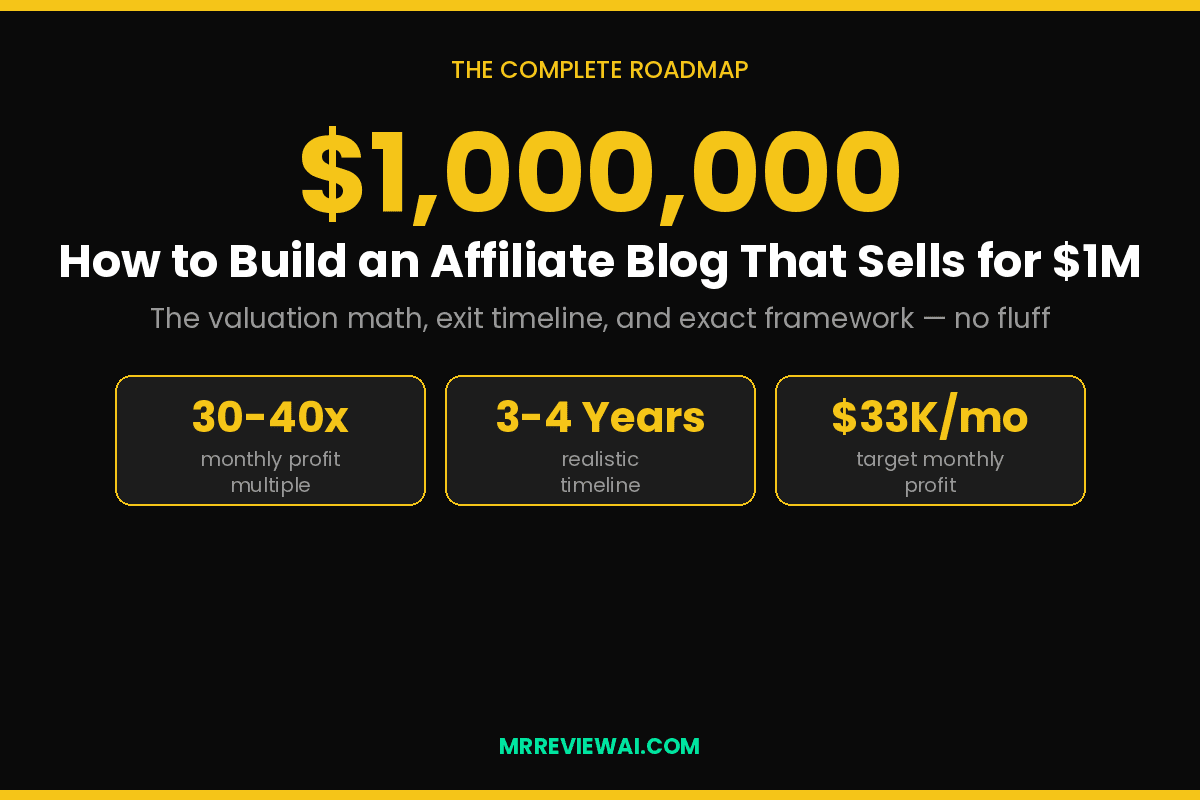
The math is straightforward: content sites generally fetch 30–40x monthly profit on the major marketplaces. That means a blog generating $30,000/month in net profit is worth approximately $900,000–$1,200,000 at exit.
This guide shows you exactly how to build toward that number — the right niche, the right content strategy, the right revenue mix, and the exact conditions that make a blog sellable at maximum multiple.
The $1M Math: How to Value the Affiliate Blog You’re Building to Sell
Before you build anything, you need to understand how buyers value what you’re building.
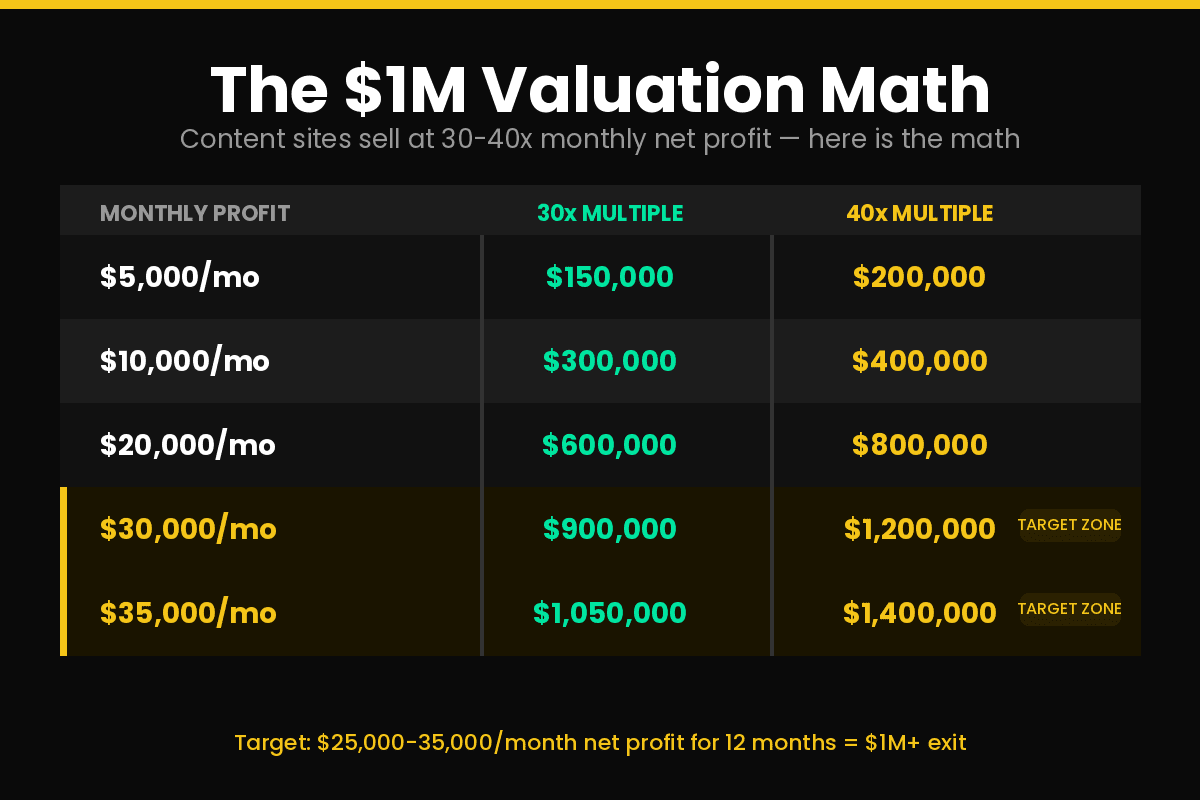
Valuation multiples typically range from 20–50x monthly profit depending on the business model. Content sites generally fetch 30–40x monthly profit, though this varies based on growth trajectory, traffic diversity, and revenue stability.
Here’s what the math looks like at different income levels:
| Monthly Net Profit | 30x Multiple | 40x Multiple |
|---|---|---|
| $5,000/mo | $150,000 | $200,000 |
| $10,000/mo | $300,000 | $400,000 |
| $20,000/mo | $600,000 | $800,000 |
| $30,000/mo | $900,000 | $1,200,000 |
| $35,000/mo | $1,050,000 | $1,400,000 |
The $1M target: You need a blog generating $25,000–$35,000/month in net profit consistently for 12 months to realistically exit at $1M+.
That’s a high bar — but a reachable one. Here’s how to get there.
Phase 1 — Choose a Niche Built for Exit Value
Not all niches are created equal when it comes to exit value — this matters especially when your goal is to build affiliate blog income that compounds over time. Buyers pay for three things: recurring revenue, defensibility, and growth potential. Your niche choice determines all three.
What Makes a High-Value Niche
High affiliate commissions. SaaS tools paying 25–40% recurring commissions generate significantly more per visitor than Amazon product reviews paying 3–8% one-time. A blog in the AI tools, email marketing, or CRM space earns far more per 10,000 monthly visitors than a blog reviewing kitchen gadgets.
Evergreen demand. Buyers want businesses that will still make money in 3 years. Niche topics tied to passing trends lose value fast. AI tools, business software, finance, and health are durable niches. Viral social media trends are not.
SaaS affiliate programs. The recurring commission model changes the exit math entirely. A single customer who subscribes to a $100/month tool at 30% commission generates $30/month — every month, without additional work. Build enough of those and your baseline revenue is defensible, predictable, and attractive to buyers.
The mrreviewai.com approach: This blog is built in the AI tools and SaaS niche — high commissions, recurring revenue, growing demand, and a clear audience (online entrepreneurs) who buy tools. That’s an intentional exit-optimized niche choice.
Niches to Avoid for $1M Exits
- Amazon affiliate only — 3–8% commissions, no recurring revenue
- Highly trend-dependent topics (specific influencers, viral moments)
- Ultra-competitive generic niches with no clear audience (general “tech news”)
- Niches with no affiliate programs and only ad revenue
Phase 2 — Build the Content Foundation for Your Affiliate Blog
Your content strategy is your long-term asset. Buyers aren’t just buying revenue — they’re buying a defensible traffic position that will keep generating revenue after acquisition.
The Content Architecture That Sells
Build around a three-pillar content structure:
Pillar 1 — Best-Of Listicles: “Best AI Writing Tools for Bloggers 2026.” These rank for high-intent keywords, drive significant traffic, and can link to multiple affiliate programs simultaneously. They’re your traffic workhorses.
Pillar 2 — Individual Reviews: “Jasper AI Review 2026.” These rank for buyer-intent keywords (“is X worth it”) and convert at higher rates than listicles. Buyers love sites with deep, trustworthy reviews because the content is harder to replicate.
Pillar 3 — Comparison Posts: “Jasper AI vs Copy.ai 2026.” These catch users at the decision stage — they’re comparing two products and already intend to buy one. Conversion rates on comparison posts are typically 2–3x higher than informational content.
The 100-Post Milestone
A blog with 30 posts and 50,000 monthly visitors is interesting. A blog with 100+ posts and 100,000+ monthly visitors is sellable.
More than ever, having documented systems and a content team in place significantly increases buyer interest and valuation multiples because it reduces transition risk.
The goal isn’t just content volume — it’s showing a buyer that the content machine works without you. By post 100, you should have a repeatable content production process: keyword research → brief → draft → edit → publish → promote. Document every step.
SEO Is Your Foundation, Not Your Only Channel
Rank for 200–300 long-tail keywords before you exit. Every ranking keyword is a defensible traffic position that a buyer can audit and value. Use tools like Ahrefs or Semrush to track ranking progress — buyers will ask for this data.
Target keyword difficulty scores under 30 for your first 50 posts. Build to harder keywords as your domain authority grows. This is a multi-year process, not a shortcut.
Phase 3 — Stack Your Revenue Streams
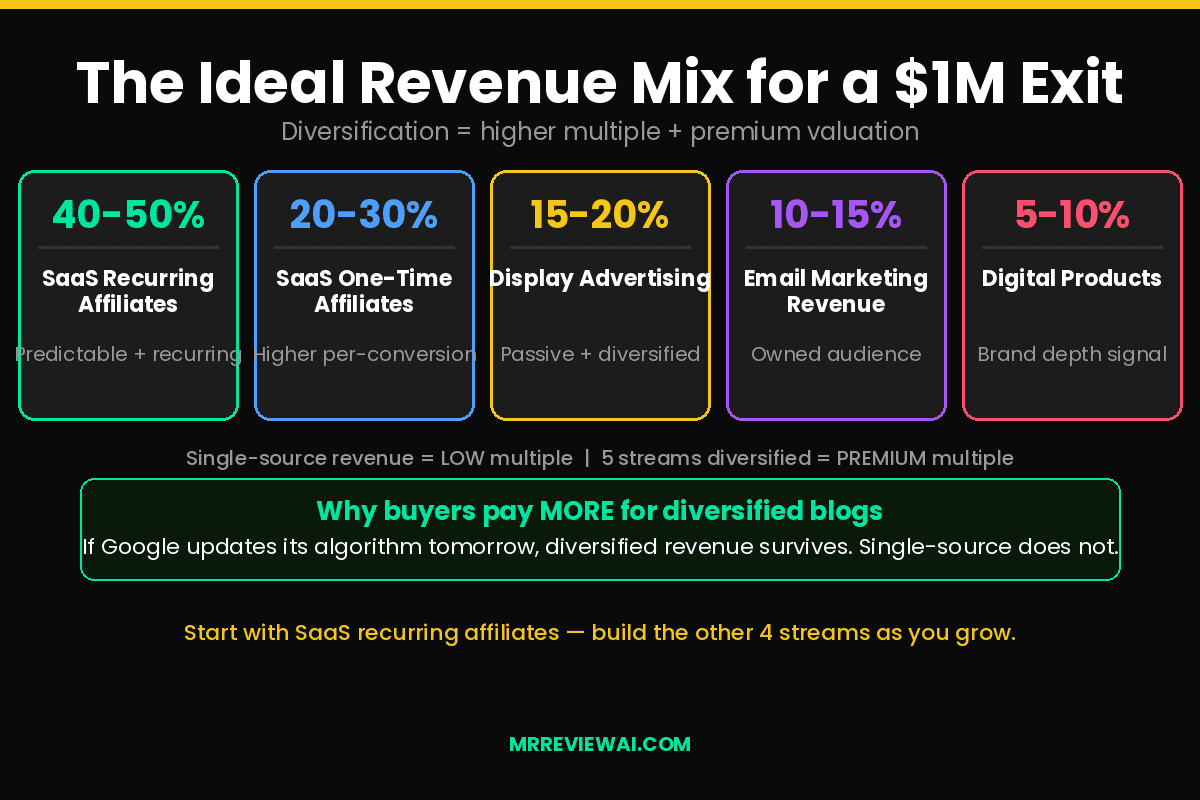
Single-source revenue is the fastest way to reduce your exit multiple. Buyers discount heavily for concentration risk — if one program represents 80% of your revenue, losing that program cuts your value by 80%.
The Ideal Revenue Mix for a $1M Exit
| Revenue Source | Target % of Total | Why Buyers Love It |
|---|---|---|
| SaaS affiliate (recurring) | 40–50% | Predictable, recurring, defensible |
| SaaS affiliate (one-time) | 20–30% | Higher payouts per conversion |
| Display advertising | 15–20% | Passive, diversified, credible |
| Email marketing revenue | 10–15% | Owned audience = lower risk |
| Digital products | 5–10% | Shows brand, not just traffic |
The Recurring Revenue Multiplier
Here’s why SaaS affiliate programs change the valuation math:
A blogger earning $10,000/month from Amazon affiliate links has roughly $0 in recurring monthly revenue — next month requires the same traffic to earn the same amount.
A blogger earning $10,000/month from SaaS recurring commissions has a portion of that income guaranteed regardless of next month’s traffic — because the subscribers they referred last month are still paying.
Having a good email list you’re using to some degree, or a social following, de-risks the business for buyers. Recurring affiliate revenue works the same way — it’s owned revenue that doesn’t disappear if Google updates its algorithm.
Priority Affiliate Programs to Apply For
Apply in this order as your blog grows:
- Copy.ai — 45% recurring commission
- Koala AI — 30% recurring commission
- Writesonic — 30% recurring commission
- Surfer SEO — 25% recurring commission
- Jasper AI — $29–59 per sale
- Semrush — $200 per sale
By the time you reach 50,000 monthly visitors, you should be active in at least 5 programs across multiple categories.
Phase 4 — Build Traffic Diversity
This is the factor that separates blogs worth $300K from blogs worth $1M+.
With Google’s algorithm changes in mid-2023 crushing many affiliate sites, businesses relying exclusively on search engine traffic have become less desirable to buyers. A blog getting 95% of its traffic from Google is a single point of failure. If the next algorithm update hits, your revenue disappears — and so does your valuation.
Buyers in 2026 are paying premium multiples for sites with diversified traffic. Here’s what diversity means in practice:
Email list: 5,000+ engaged subscribers means your audience is yours regardless of what Google does. Build this from day one — even a free lead magnet and a ConvertKit or MailerLite account is enough to start.
Pinterest: For content sites in the online business and “make money” niche, Pinterest can drive 20–40% of total traffic once a consistent pinning strategy is in place. 80 pins per month, consistent branding, keyword-rich descriptions.
Social presence: YouTube, LinkedIn, or Instagram don’t need massive followings to count for buyers. A YouTube channel with 2,000 subscribers and regular uploads shows that the brand exists beyond Google. It shows effort, it shows diversification, and it shows brand building.
Direct/returning traffic: A percentage of visitors who come directly — typing your URL or clicking a bookmark — is the strongest signal of brand loyalty. This grows naturally as your content quality improves and your email list grows.
Target traffic mix before exit:
- Organic search: 60–70%
- Email: 10–15%
- Pinterest + social: 15–20%
- Direct: 5–10%
Phase 5 — Systematize Everything
A blog that runs on you is worth one multiple. A blog that runs without you is worth a higher multiple.
Having a team in place and documented processes significantly increases buyer interest and valuation multiples because it reduces transition risk — and it shows you’ve managed to build affiliate blog operations that scale beyond just one person.
This is the most overlooked phase of building for exit. Buyers aren’t just acquiring content — they’re acquiring a business they can operate or hand to someone else. If the entire operation lives in your head, they’re buying a job, not a business.
What to Document
Content production SOP: How you research keywords, brief writers, review drafts, publish, and promote each post. If a new writer could follow your process without asking you a single question, it’s documented well enough.
Affiliate management process: How you apply to programs, rotate links, track performance, and update affiliate links when programs change. This should be a live document, not memory.
Technical operations: Hosting setup, backup procedures, plugin management, image optimization workflow. A buyer’s due diligence team will ask about this.
Traffic and revenue reporting: Monthly reports showing traffic trends, ranking improvements, revenue by source, and email list growth. Buyers want to see 12 months of clean, consistent data.
Build a Small Team
A solopreneur blog can sell. A blog with one part-time editor, one part-time writer, and documented processes sells for more — and sells faster.
The goal isn’t to build a large team. It’s to show that the operation isn’t dependent on one person. Even a VA handling image uploads and social scheduling shows systematization.
Phase 6 — Prepare for Exit
Most bloggers who want to sell aren’t ready to sell when they think they are. Preparation typically takes 6–12 months before the actual listing.
Clean Financials Are Non-Negotiable
Empire Flippers requires profit and loss statements for the past 12+ months, access to analytics platforms, backend access to verify monetization, and proof of business ownership.
Start tracking P&L rigorously 12+ months before you plan to exit. Use a simple spreadsheet or accounting software tracking: affiliate revenue by program, display ad revenue, expenses (hosting, tools, freelancers), and net profit each month.
Buyers and brokers will calculate your valuation based on your trailing 12-month average net profit (L12M). Every month of clean, growing, documented profit adds to your multiple.
What Increases Your Multiple
The multiple reflects your business’s stability, growth trend, and transferability — higher risk businesses receive lower multiples, while established operations with consistent earnings secure higher ones.
Factors that push you toward 35–40x instead of 25–30x:
- Consistent month-over-month revenue growth (even 3–5% monthly)
- Multiple traffic sources (email, social, search — not just Google)
- Recurring affiliate revenue as a percentage of total income
- Documented SOPs and a small operational team
- Domain Rating (DR) 30+ with quality backlinks
- Email list of 5,000+ engaged subscribers
- Clean 12-month P&L with no unexplained revenue drops
Choose Your Exit Platform
For a $1M exit, Empire Flippers is the right platform. Empire Flippers boasts 325,000 buyers and sellers and 12.5+ billion dollars in verified liquidity.
If you have an affiliate site right now and you’re looking for a multiple six-figure payout, now is a pretty good time — buyers are actively looking for quality content businesses.
Get a free valuation from Empire Flippers 6–12 months before your target exit date. Their assessment will tell you what’s missing and give you time to fix it before you officially list.
The Realistic Timeline
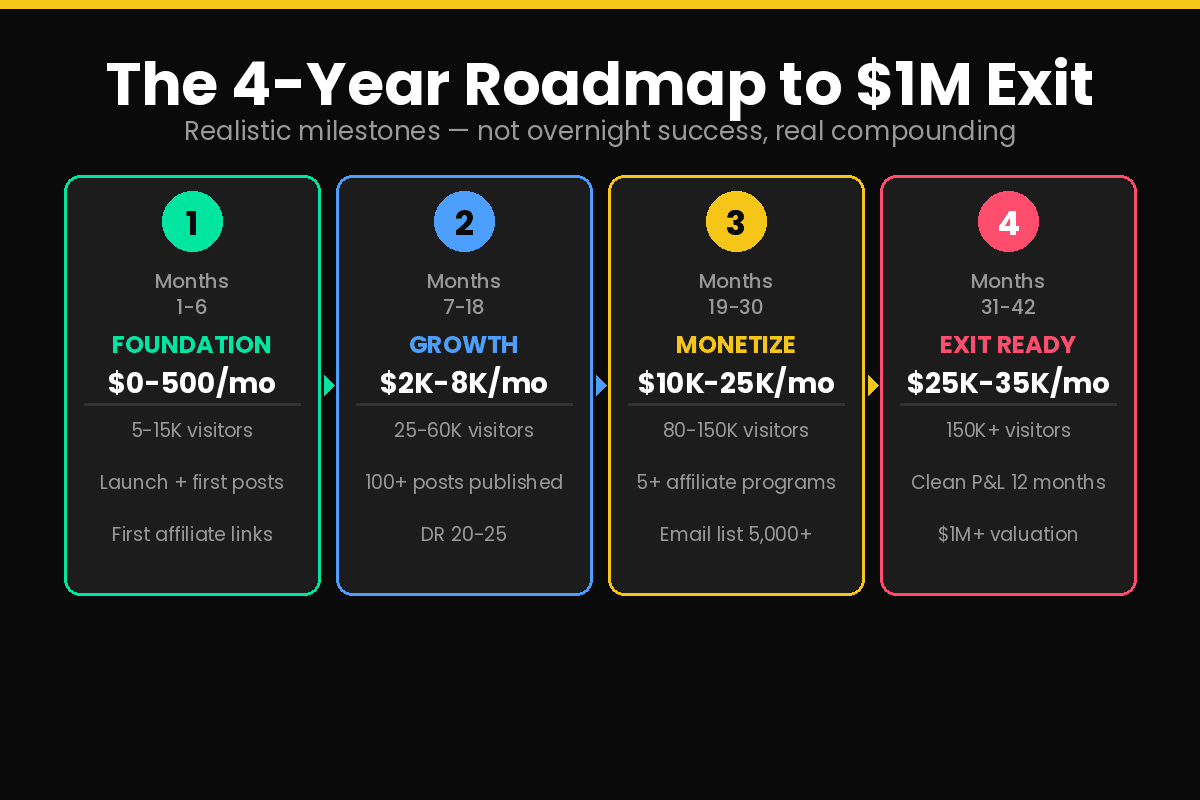
Here’s a grounded timeline for building from zero to $1M exit:
Months 1–6 — Foundation
- Choose niche and launch WordPress site
- Publish 2–3 posts per week targeting low-competition keywords
- Apply to first 2–3 affiliate programs
- Start Pinterest and email list from day one
- Target: 5,000–15,000 monthly visitors, $0–500/month revenue
Months 7–18 — Growth
- Scale to 100+ published posts
- Reach domain authority 20–25 with intentional link building
- Apply to higher-paying affiliate programs (Semrush, Jasper)
- Build email list to 1,000+ subscribers
- Target: 25,000–60,000 monthly visitors, $2,000–8,000/month revenue
Months 19–30 — Monetization
- Optimize top 20 posts for conversion (better CTAs, comparison tables, FAQ schema)
- Diversify revenue across 5+ programs
- Launch YouTube or Pinterest at scale for traffic diversification
- Build email list to 5,000+ subscribers
- Target: 80,000–150,000 monthly visitors, $10,000–25,000/month revenue
Months 31–42 — Exit Preparation
- Document all SOPs
- Clean up P&L for 12 consecutive months
- Reach DR 30+ and stable traffic from multiple sources
- Get Empire Flippers valuation at month 36
- Target: $25,000–35,000/month net profit → $1M+ exit valuation
That’s a 3–4 year timeline to a $1M exit. It’s not quick. But it’s real — and every month of consistent execution compounds toward the exit number.
What Kills Your Valuation
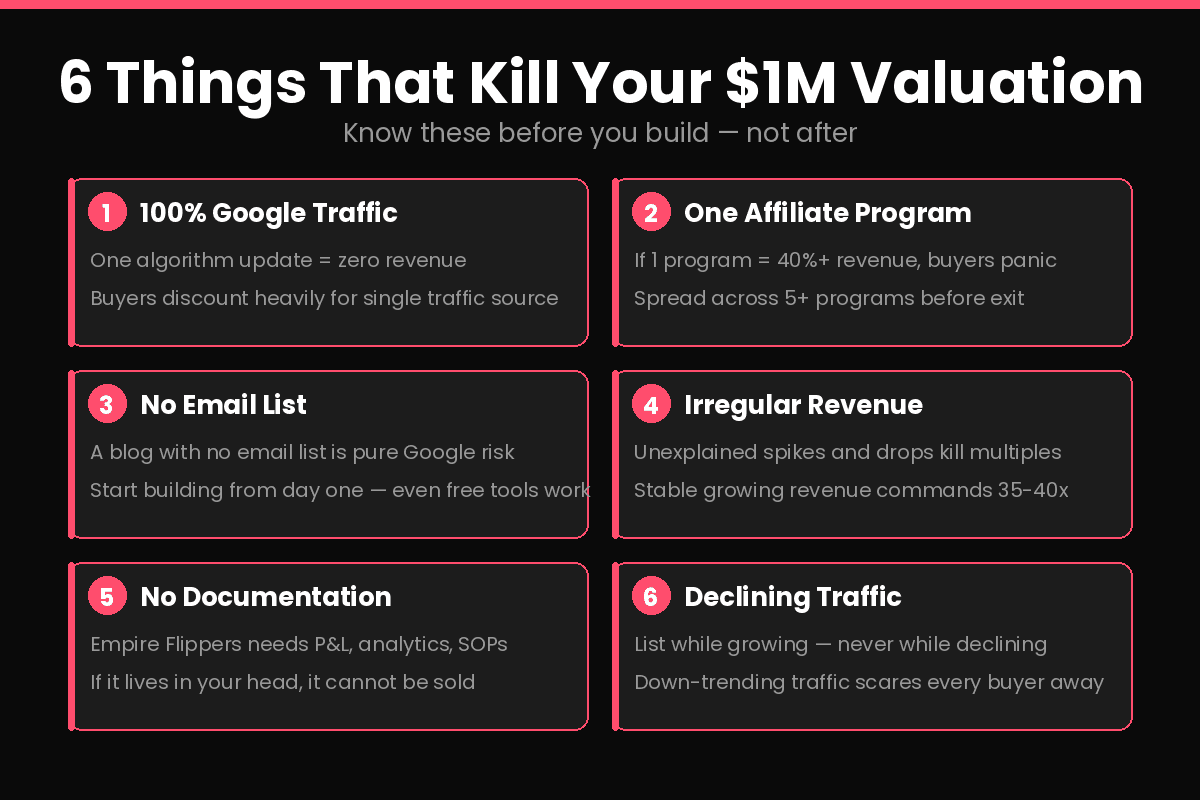
Know these before you build, not after:
100% Google-dependent traffic. Businesses relying exclusively on search engine traffic have become less desirable to buyers following Google’s algorithm changes in mid-2023. Diversify before you list, not the week before.
Single affiliate program concentration. If Amazon, Jasper, or any single program represents more than 40% of your revenue, buyers will discount heavily. Spread across 5+ programs before exit.
No email list. A blog with 100,000 monthly visitors and zero email subscribers is a pure Google dependency play. Buyers know this. Start building your list from day one.
Irregular or unexplained revenue. A sudden revenue spike followed by a drop, or inconsistent earnings month to month, will reduce your multiple or kill the sale entirely. Stable, growing revenue is what commands 35–40x.
No documentation. Empire Flippers’ vetting team conducts thorough due diligence and requires complete P&L statements, analytics access, and detailed documentation of business operations. If you can’t provide this, you can’t list.
Declining traffic trend. Even if monthly profit looks good, a downward traffic trend over 6 months will scare buyers. List while you’re growing, not while you’re declining.
The Honest Reality
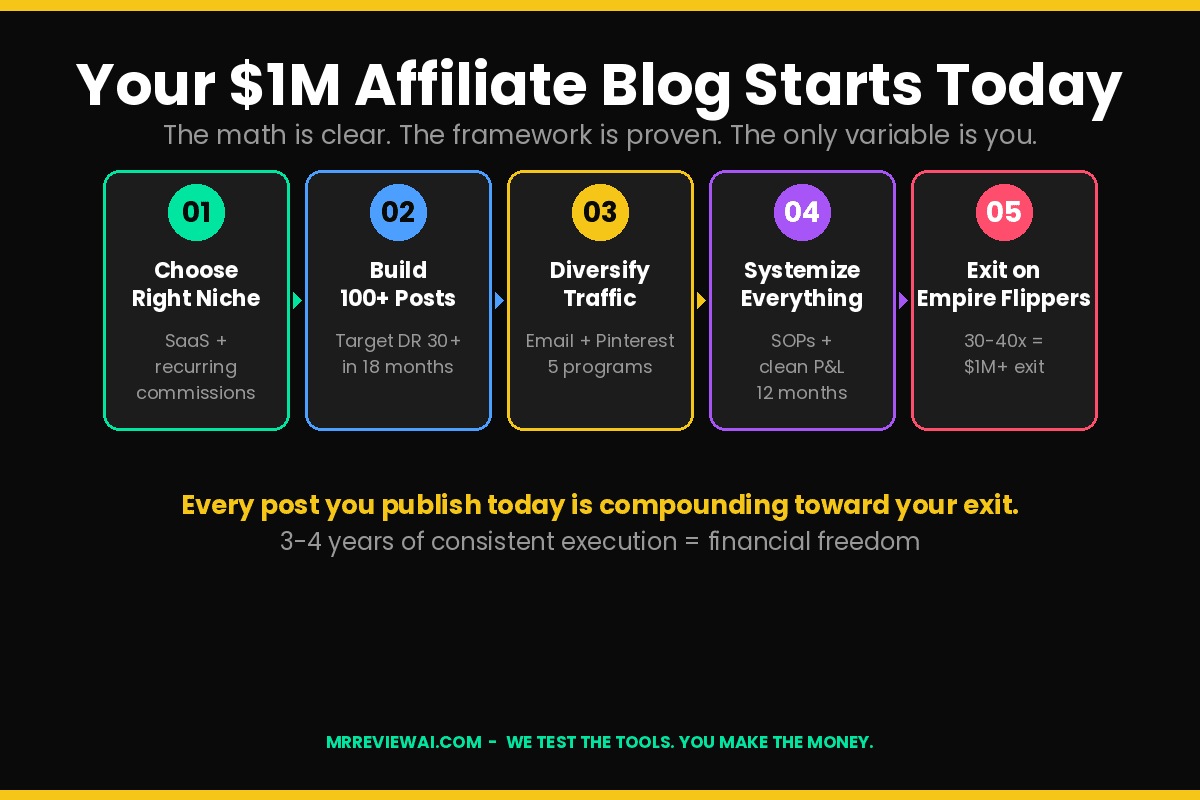
Building a $1M affiliate blog that sells takes 3–4 years of consistent execution. There are no shortcuts, no algorithm hacks, and no overnight success stories that hold up to scrutiny.
What there is: a clear, repeatable framework that hundreds of bloggers have followed to seven-figure exits. Choose the right niche, publish high-quality content consistently, diversify your traffic and revenue, systematize your operations, and prepare your financials for exit.
The bloggers who sell for $1M aren’t smarter than you. They’re the ones who kept going past month 12 when most quit — and who understood from day one that they were building an asset, not just writing posts.
Start with the tools that will power your content machine. See Best AI Writing Tools for Bloggers 2026 for the stack we use daily. And see Best SaaS Tools for Solopreneurs 2026 for the full operational toolkit.
FAQ
How to Build Affiliate Blog Sell 1 Million: Quick Reference
How much does an affiliate blog need to make to sell for $1 million?
At current market multiples of 30–40x monthly net profit, a blog needs to generate $25,000–$33,000 per month in net profit consistently over 12 months to reach a $1M valuation. The exact multiple depends on traffic diversity, revenue stability, growth trend, and whether the business is systematized.
How long does it take to build an affiliate blog worth $1 million?
Realistically, 3–4 years from launch to exit for a blogger working consistently. The timeline depends heavily on niche, content quality, link building strategy, and how quickly you diversify revenue and traffic. Bloggers in high-commission SaaS niches can reach the target faster than those in low-commission product niches.
Where do I sell an affiliate blog for the best price?
Empire Flippers is the leading marketplace for content sites in the $500K–$3M range. They have 325,000+ verified buyers, handle the migration process, and have closed over $500 million in online business sales. Get a free valuation 6–12 months before your target exit to understand what improvements will increase your multiple.
What multiple do affiliate blogs sell for in 2026?
Most quality affiliate blogs sell for 28–34x monthly net profit on Empire Flippers in 2026. High-quality sites with diversified traffic, recurring affiliate revenue, documented systems, and strong growth trends can achieve 35–40x. Sites with single-source traffic or revenue concentration typically sell at 20–28x.
Does an affiliate blog need a team to sell for $1M?
Not necessarily, but it helps significantly. A solo-operated blog can sell — but documented SOPs and even one part-time contractor handling content or operations signals to buyers that the business can run without the owner. This reduces perceived risk and increases your multiple by 5–10x in many cases.
Last updated: May 2026. Valuation data sourced from Empire Flippers marketplace and industry reports.
Free Download
Get My Free List: 10 Best AI Tools for Bloggers
The exact free tools I use weekly to run mrreviewai.com — delivered to your inbox instantly.
🔒 No spam. Unsubscribe anytime.