Midjourney Review 2026: Is It Still the Best AI Art Tool?
Disclosure: This post contains affiliate links. If you purchase through them, I may earn a commission at no extra cost to you. I only recommend tools I’ve actually tested.
Three years ago, Midjourney was the only serious answer to “what’s the best AI image generator?” Today it has real competition — FLUX, Adobe Firefly, Google Gemini, Ideogram — and the question is no longer just “is Midjourney good?” but “is Midjourney still worth paying for when good alternatives are cheaper or free?”
I’ve been using Midjourney for blog graphics, social media images, and content thumbnails for over a year. This Midjourney review 2026 covers the current state of V7 (the default model), V8 alpha (currently in preview), pricing, what it does better than competitors, and who should honestly skip it.
Short answer: Midjourney V7 is still the benchmark for artistic quality. But the value case in 2026 is more nuanced than it used to be.
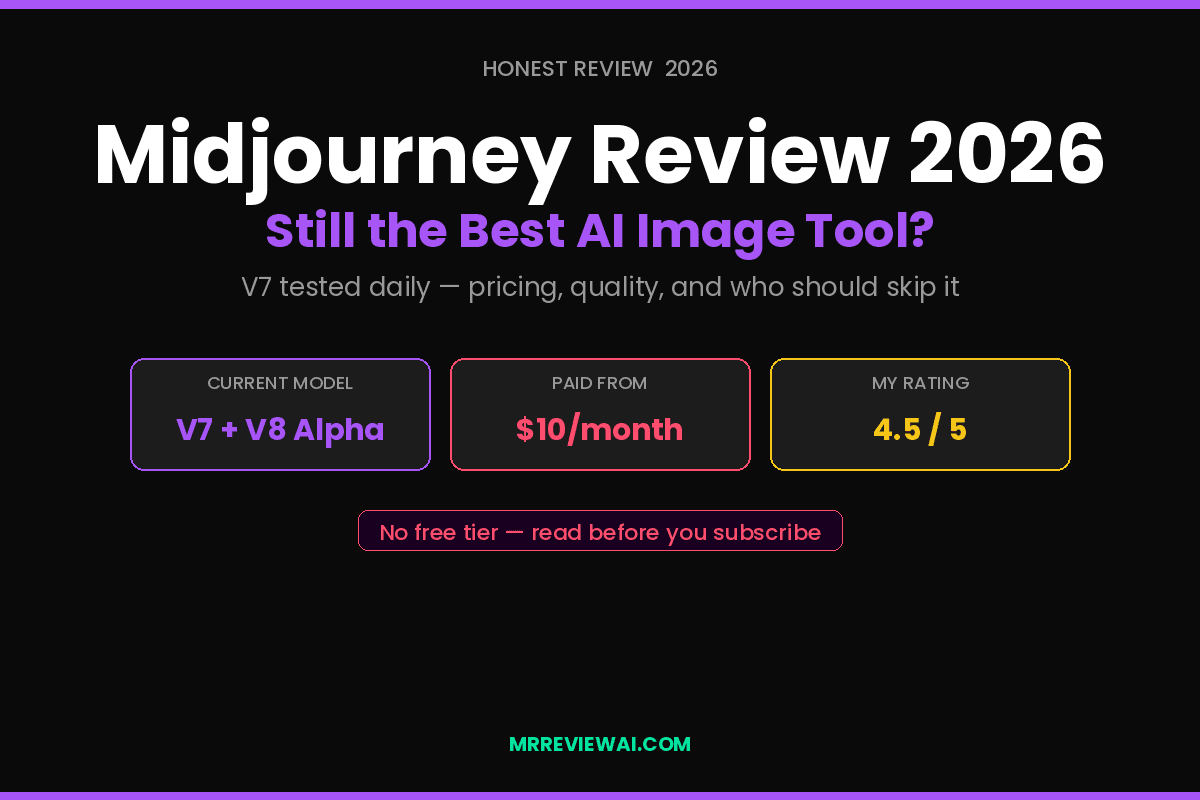
Quick Verdict: Midjourney Review 2026
| Current model | V7 (default) + V8 Alpha in preview |
| Best for | Artistic quality, editorial images, creative professionals |
| Free plan | No permanent free tier |
| Paid from | $10/month (Basic) |
| Biggest strength | Unmatched visual quality and artistic style range |
| Biggest weakness | No free tier, Discord-first interface, no text in images |
| My rating | 4.5/5 for quality-focused creators |
Table of Contents
- What Is Midjourney in 2026?
- Midjourney V7 vs V8 Alpha — What Changed
- Midjourney Pricing 2026
- Image Quality Test — Honest Results
- Key Features for Bloggers
- What Midjourney Does Well
- What Midjourney Does Badly
- Who Should NOT Use Midjourney
- Midjourney vs Alternatives
- Final Verdict
- FAQ
What Is Midjourney in 2026?
In this Midjourney review 2026, This Midjourney review 2026 starts with the basics: In this Midjourney review 2026, these are the key features: In this Midjourney review 2026, In this Midjourney review 2026, here’s how it compares: Midjourney is an independent AI image generation platform built by Midjourney Inc., founded by David Holz in 2022. After this Midjourney review 2026 analysis, It started as a Discord bot and has since evolved into a full web application at midjourney.com — though Discord access is still supported for users who prefer it.
What makes Midjourney different from every other AI image tool is its aesthetic philosophy. Where tools like FLUX optimize for photorealistic accuracy and Adobe Firefly prioritizes commercial safety, Midjourney optimizes for images that look visually striking. The results tend to be more cinematic, more stylized, and — in the eyes of most designers and artists — more impressive than what competitors produce.
As of 2026, Midjourney V7 is the platform’s default model and V8 Alpha has been rolling out since March 2026 with native 2K rendering and faster generation. The platform has genuinely grown from a clever Discord bot into a real image workspace — but that evolution also comes with an evolved pricing structure and no free tier.
Midjourney V7 vs V8 Alpha — What Changed
Understanding the current model situation is important before making a purchase decision.
V7 (Current Default)
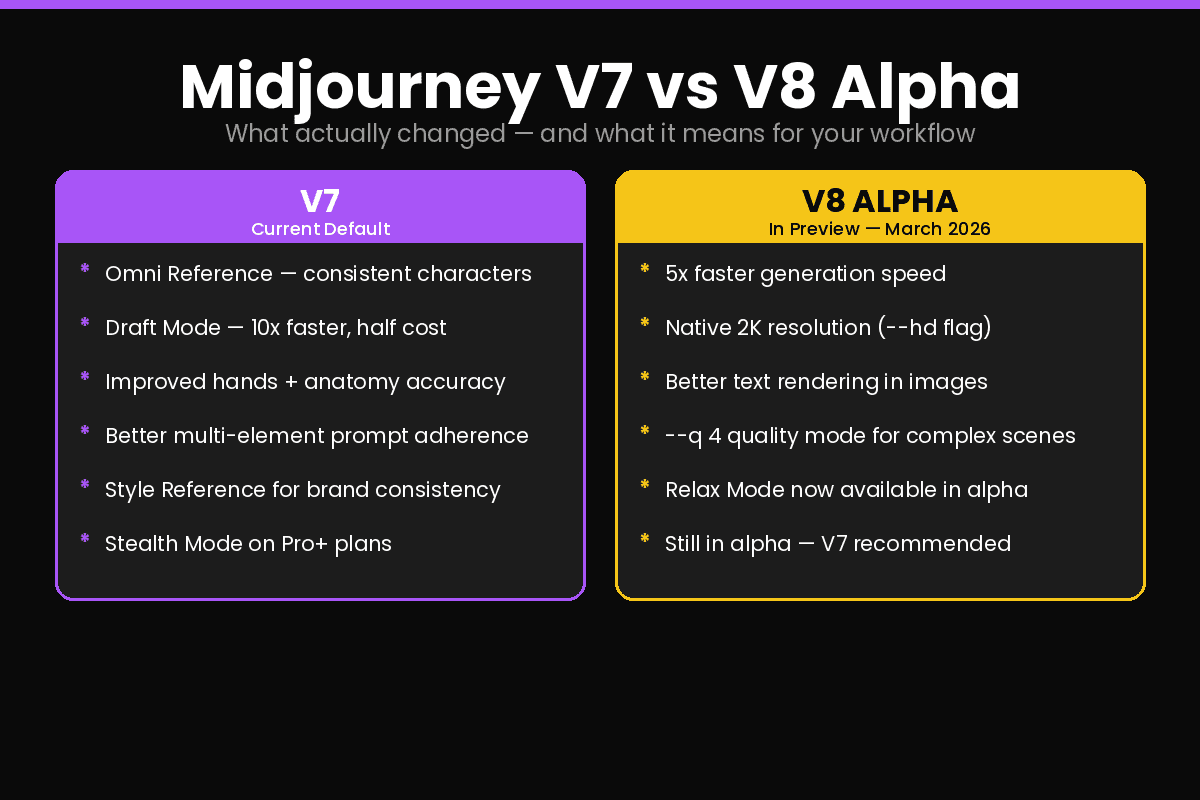
Midjourney V7 was released in alpha on April 3, 2025 and set as the default model on June 17, 2025. Key improvements include smarter prompt understanding, stunning improvements in realism with richer textures and better coherence in bodies and hands, and new Draft Mode that is 10x faster at half the cost.
The biggest practical change in V7 for bloggers and content creators:
Omni Reference — maintains consistent character or subject appearance across multiple generations. If you’re building a visual brand identity with a recurring character or product, this is genuinely useful.
Draft Mode — generates images at 10x speed for roughly half the credit cost. For content creators who need quick thumbnails and social graphics, not gallery-quality artwork, Draft Mode changes the economics significantly.
Improved hands and anatomy — V6’s notorious hand problems are largely fixed. Not perfect, but dramatically improved.
V8 Alpha (In Preview)
V8 Alpha launched March 17, 2026 with approximately 5x faster generation, native 2K resolution via the –hd flag, better text rendering, and a –q 4 quality mode for complex scenes.
V8 is not yet the default — it requires opting in. The faster generation and improved text rendering are meaningful upgrades. However, it’s still alpha, which means occasional inconsistencies. For production work, stick with V7 until V8 exits alpha.
Midjourney Pricing 2026
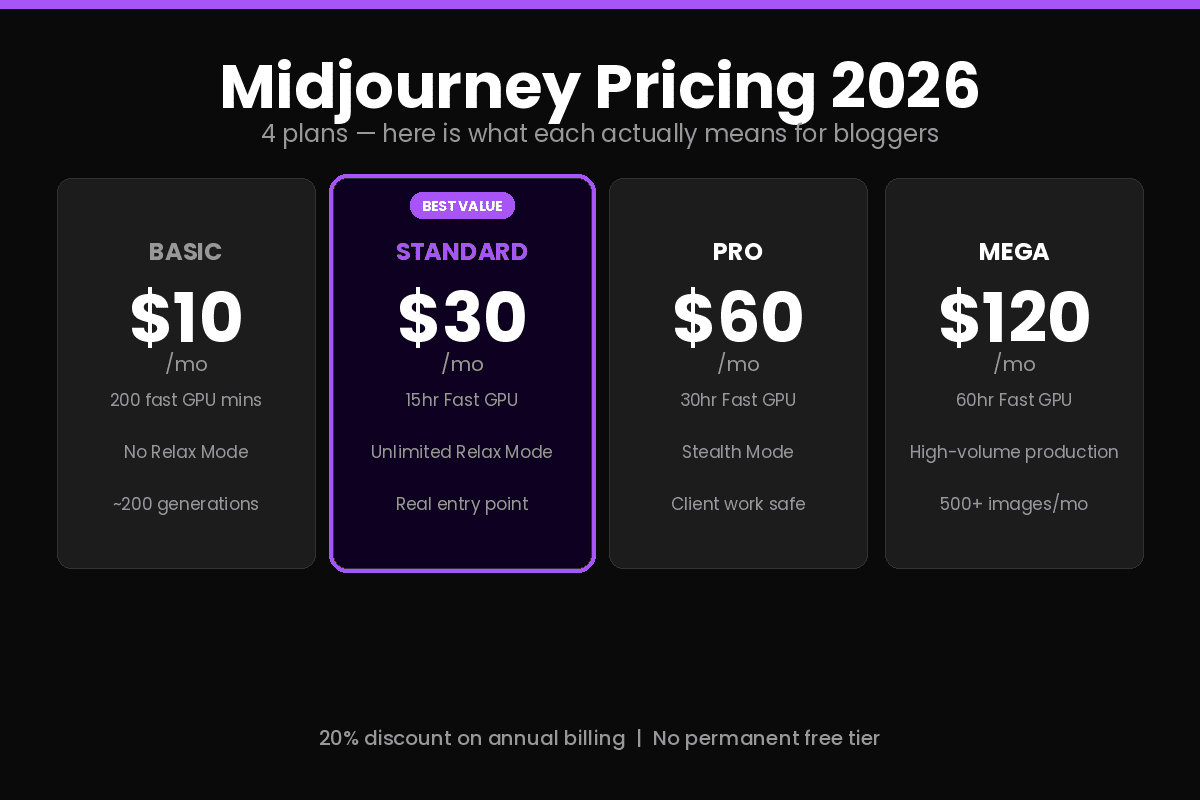
Midjourney’s official subscriptions start at $10, $30, $60, and $120 per month, with a 20% discount for annual billing.
Here’s what each plan actually means for a content creator:
Basic Plan — $10/month
200 minutes of Fast GPU time per month. No Relax Mode. Roughly 200 standard image generations depending on complexity.
The catch: Once you burn through the fast GPU time, Basic stops being useful. For a blogger creating 5-6 images per blog post, 200 generations disappear quickly.
Best for: Casual users, beginners testing the platform, or anyone who only needs images occasionally.
Standard Plan — $30/month
15 hours of Fast GPU time plus unlimited Relax Mode generations. This is the plan where Midjourney transforms from “expensive hobby” to a cost-effective production tool.
Relax Mode uses shared GPU resources and takes 3–5 minutes per image during busy periods — but it’s unlimited. For bloggers who plan ahead and aren’t in a rush, Standard is the real entry point for unlimited use.
Best for: Regular content creators who need consistent image generation without usage caps.
Pro Plan — $60/month
30 hours Fast GPU, unlimited Relax Mode, plus Stealth Mode — your generations aren’t visible in the public Midjourney gallery. Essential for anyone creating images for client work or proprietary brand content.
Best for: Freelancers, agencies, and businesses where privacy of generated content matters.
Mega Plan — $120/month
60 hours Fast GPU, unlimited Relax, Stealth Mode. For high-volume production workflows.
Best for: Teams generating hundreds of images per month for commercial campaigns.
Commercial Use Rights
All paid plans include commercial use rights. One important caveat: businesses with more than $1M annual gross revenue need Pro or Mega for commercial use under Midjourney’s terms.
My Pricing Recommendation for Bloggers
| Usage | Plan | Reasoning |
|---|---|---|
| Testing Midjourney | Basic $10 | Enough to evaluate quality |
| 1-3 blog posts/week | Standard $30 | Unlimited Relax Mode justifies the jump |
| Client work / agencies | Pro $60 | Stealth Mode essential |
| High-volume production | Mega $120 | Only if generating 500+ images/month |
Image Quality Test — Honest Results
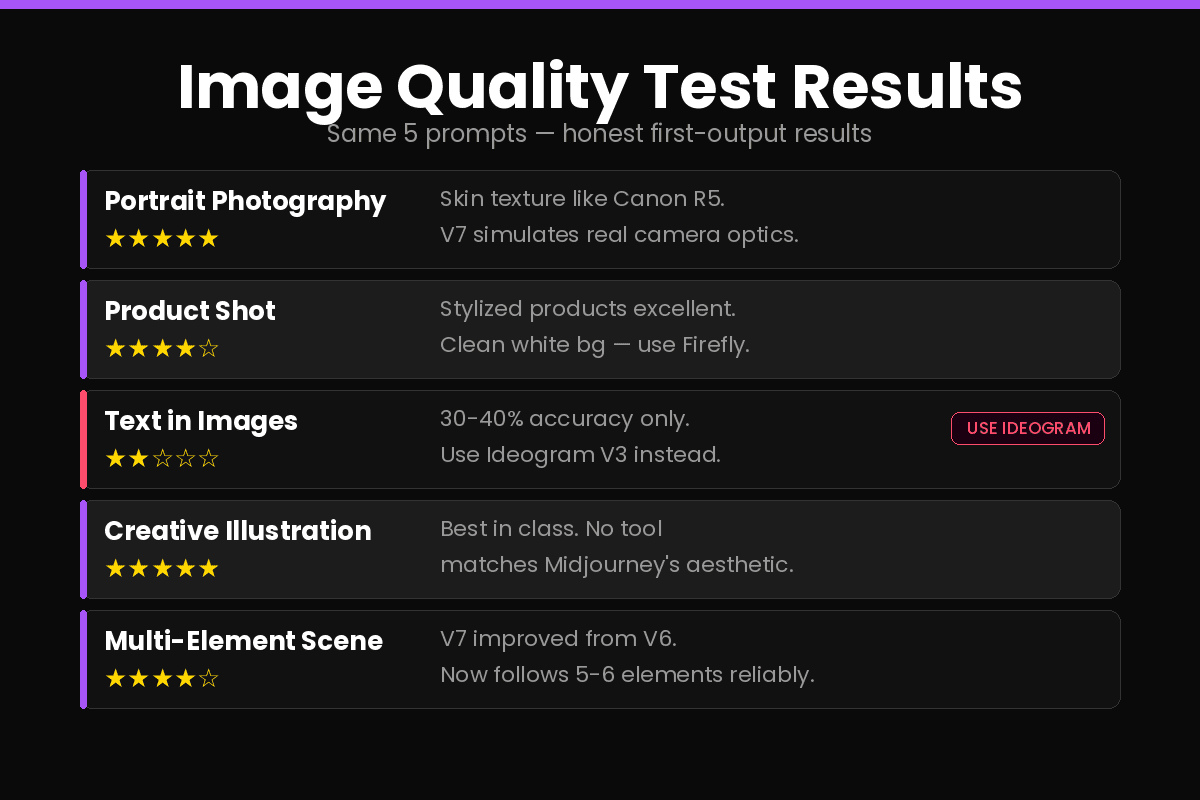
I tested Midjourney V7 with the same five prompts I use across all AI image tools for this blog:
Portrait photography prompt: V7 produces skin texture, lighting, and imperfections that look genuinely photographic. One photographer’s take after testing: “V6 looks like a good Instagram filter. V7 looks like I shot it with my Canon R5. The difference is in the imperfections.”
Product shot prompt: Results are excellent for stylized product imagery. Less ideal for clean white-background commercial photography where Adobe Firefly’s licensed assets are a better choice.
Text-in-image prompt: This is Midjourney’s persistent weakness. Text accuracy is roughly 30–40% — significantly behind Ideogram V3’s 90–95%. Do not use Midjourney when readable text in the image matters.
Abstract creative illustration: Midjourney wins this category decisively. The aesthetic range, the cinematic quality, the “this looks like a professional designed it” feeling — no other tool matches it.
Complex multi-element scene: V7 significantly improved on V6 here. Multi-element prompts now adhere more reliably to all specified elements rather than dropping secondary subjects.
Overall quality verdict: For artistic, editorial, and creative content — Midjourney V7 is still the benchmark. For commercial product photography and text-in-image work — competitors are better suited.
Key Features for Bloggers
Draft Mode
The most underrated V7 addition for content creators. 10x faster generation at roughly half the credit cost — ideal for blog thumbnails, social media graphics, and quick visual iterations. Quality is slightly lower than standard generation but more than adequate for web use.
Style Reference
Upload an image as a style reference and Midjourney generates content matching that aesthetic. Excellent for maintaining consistent visual branding across a blog’s featured images without rebuilding the same prompt every time.
Omni Reference
Keeps a specific character, object, or subject consistent across multiple generations. For bloggers creating series content or building a mascot/character for their brand, this is genuinely useful.
Aspect Ratio Control
Midjourney supports aspect ratios up to 4:1, making it one of the most flexible tools for panoramic and cinematic compositions. For bloggers: set 3:2 for blog featured images, 9:16 for Pinterest and Instagram Stories, 16:9 for YouTube thumbnails.
Vary and Pan
Extend an image outward (pan) or create variations of a specific region (vary). Useful for creating slight variations of a hero image for A/B testing or adapting one image to multiple crop ratios.
What Midjourney Does Well
Artistic quality is still unmatched. The gap between Midjourney and competitors has narrowed but hasn’t closed. If the image needs to look visually stunning — editorial blog headers, social media content designed to stop the scroll — Midjourney consistently outperforms every other tool.
Style range is extraordinary. From photorealistic portraits to watercolor illustrations to anime to brutalist graphic design — Midjourney handles more aesthetic territory than any competitor.
V7 improvements are real. Hands, anatomy, complex multi-element scenes, and prompt adherence are all measurably better than V6. The learning curve from V6 to V7 is minimal — all prompt skills transfer directly.
Full web app is now mature. The early Discord-only frustration is largely addressed. Midjourney.com is a proper web interface with a gallery, prompt history, and parameter controls — though Discord still works for users who prefer it.
Commercial rights on all paid plans. No extra licensing fees for using generated images in commercial content.
What Midjourney Does Badly
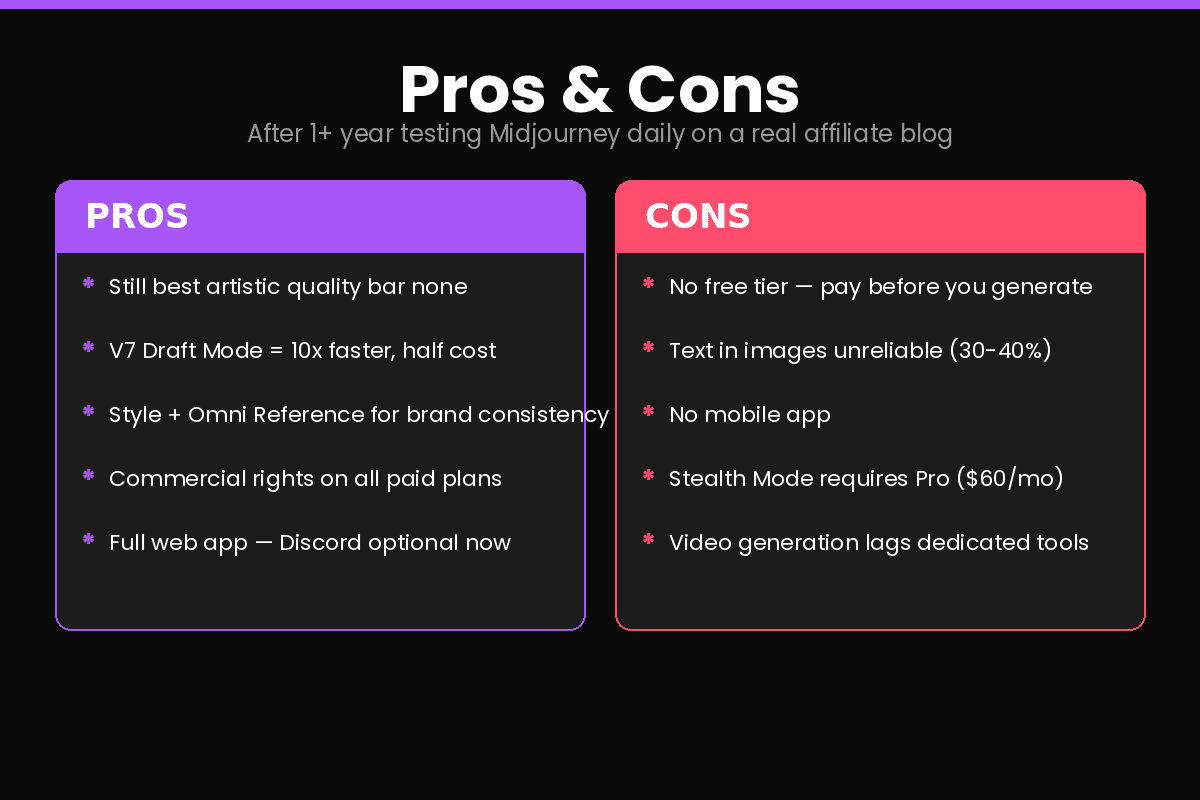
No free tier. This is the most significant friction point. Every major competitor offers a free plan — Adobe Firefly (250 credits/month), Ideogram (daily free credits), Google Gemini (included free), Stable Diffusion (free self-hosted). Midjourney asks you to pay before generating a single image. The starting price of $10/month is reasonable, but the lack of any free evaluation makes it harder to recommend to beginners.
Text in images is unreliable. At roughly 30–40% text accuracy, Midjourney is the wrong tool for any image requiring readable text — signs, logos, posters, thumbnails with overlay text. Use Ideogram V3 for these.
No mobile app. Midjourney has no dedicated mobile app. The web interface works on mobile browsers reasonably well, but most power users prefer desktop for prompt writing and parameter management.
Stealth Mode requires Pro ($60/month). If your generated images shouldn’t appear in the public Midjourney gallery — which they do by default on Basic and Standard — you’re paying $60/month minimum. For bloggers creating content for clients or proprietary brand work, this is a significant price jump.
Video generation is limited. Midjourney’s video model animates a single image into short clips but the cost is extremely high and results are better achieved with dedicated video tools like Kling, Veo, or Higgsfield. Don’t choose Midjourney for video.
Who Should NOT Use Midjourney
Don’t use Midjourney if:
- You need a free option. Google Gemini is free and produces excellent quality for most blog use cases. Ideogram’s free tier is generous. There’s no reason to pay $10/month before you’ve validated that image generation fits your workflow.
- Text accuracy matters. Posters, thumbnails with overlay text, branded graphics with logos or names — use Ideogram V3 at $7/month. The 90–95% text accuracy vs Midjourney’s 30–40% is not close.
- You’re creating commercial product photography. Adobe Firefly’s commercially-safe training data and clean product output is better suited for ecommerce and brand product shots.
- You need privacy on Basic or Standard. Images you generate on these plans are visible in Midjourney’s public gallery. If that’s a problem, you’re looking at Pro at $60/month minimum.
- You primarily need AI video. Midjourney’s video feature is behind dedicated tools. Pay for Midjourney for images and use a separate tool for video.
Midjourney vs Alternatives
| Tool | Midjourney V7 | FLUX 1.1 Pro | Adobe Firefly | Ideogram V3 |
|---|---|---|---|---|
| Image quality | ★★★★★ | ★★★★★ | ★★★★☆ | ★★★★☆ |
| Text in images | ★★☆☆☆ | ★★★☆☆ | ★★★☆☆ | ★★★★★ |
| Free plan | No | No | 250 credits/mo | Yes |
| Paid from | $10/mo | $0.03/image | $9.99/mo | $7/mo |
| Commercial rights | Yes (paid) | Yes | Yes (licensed) | Yes |
| Best for | Artistic quality | Per-image value | Commercial safe | Text in images |
For a full comparison, see Best AI Image Generator Tools 2026.
Final Verdict
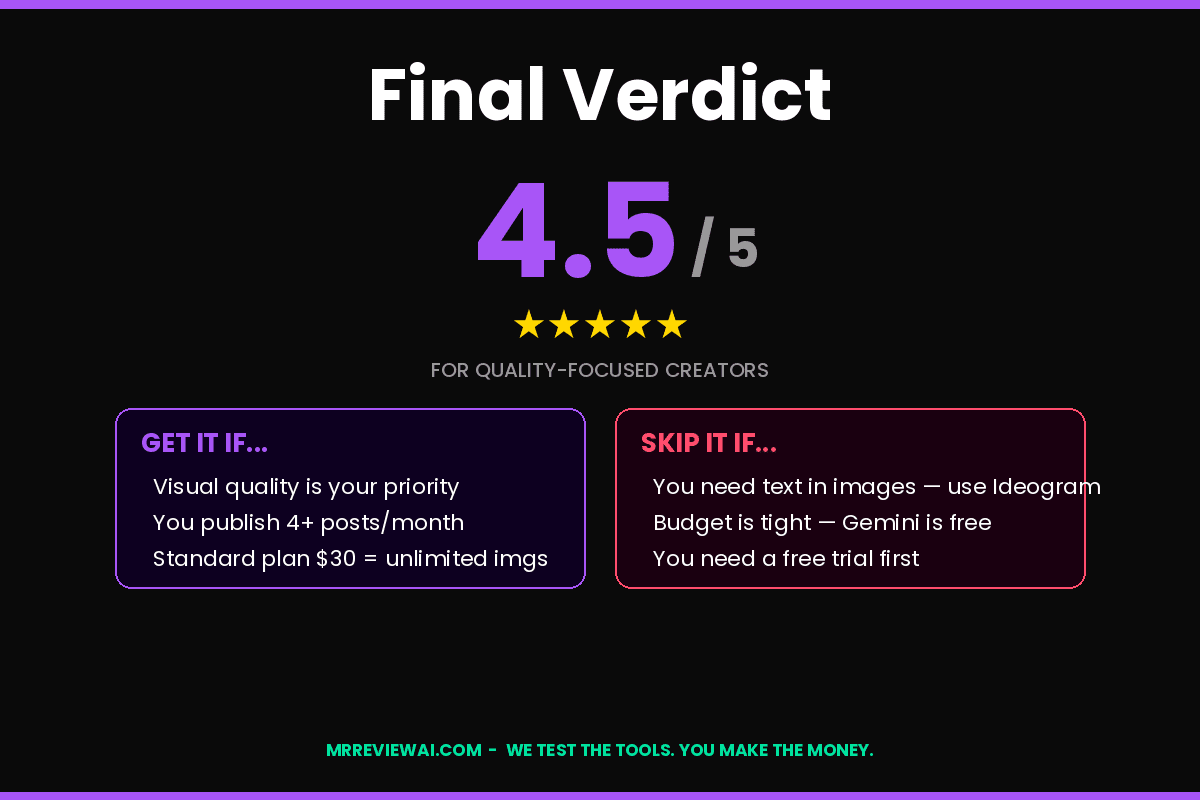
Is Midjourney worth it in 2026?
For content creators who prioritize visual quality above everything else — yes. Midjourney V7 is still the most visually impressive AI image tool available. The Standard plan at $30/month with unlimited Relax Mode generations gives you effectively unlimited images for one flat fee, which changes the value math significantly.
For bloggers just starting out — start with Google Gemini (free) or Ideogram ($7/month) first. Validate that AI image generation fits your workflow before committing $30/month to Midjourney. The quality gap is real, but it only matters if you’re creating content where visual quality is a differentiator.
For anyone who needs text in images — Ideogram V3 at $7/month is the correct choice. The quality difference in text rendering is too large to overcome with Midjourney’s strengths.
The honest one-sentence verdict: Midjourney V7 remains the best tool for artistic AI image generation in 2026 — but “best” now requires $30/month and an understanding of what it doesn’t do well.
For the full AI image generator comparison, read Best AI Image Generator Tools in 2026. And for building the full content creation stack, see Best AI Writing Tools for Bloggers 2026.
FAQ
Midjourney Review 2026: Is it still the best AI image generator?
Based on this Midjourney review 2026 analysis: for artistic quality and visual impact, yes — Midjourney V7 remains the benchmark. However, FLUX 1.1 Pro now matches it for photorealism at a fraction of the cost, and Ideogram V3 significantly outperforms it for text-in-image accuracy. Midjourney leads on aesthetic quality and style range, but it’s no longer the only serious option.
How much does Midjourney cost in 2026?
In this Midjourney review 2026, we confirmed that Midjourney plans start at $10/month (Basic, 200 fast GPU minutes), $30/month (Standard, unlimited Relax Mode), $60/month (Pro, adds Stealth Mode), and $120/month (Mega, highest GPU hours). Annual billing saves 20%. There is no permanent free tier.
Is there a free trial for Midjourney in 2026?
There is no permanent free trial. Midjourney occasionally re-enables limited free trials for new users but this is not consistently available. If you need a free AI image tool, Google Gemini offers the best free quality, and Adobe Firefly provides 250 free credits per month.
What is Midjourney V8?
Midjourney V8 Alpha launched March 17, 2026. It offers approximately 5x faster generation, native 2K resolution with the –hd flag, improved text rendering, and a –q 4 quality mode. V8 is currently in alpha preview — V7 remains the default model. V8 should exit alpha and become the default later in 2026.
Is Midjourney good for bloggers? (Midjourney review 2026)
Yes, for bloggers who prioritize visual quality in their featured images and social media graphics. The Standard plan at $30/month with unlimited Relax Mode is the practical entry point. If budget is tight, start with Google Gemini (free) and upgrade to Midjourney once your blog generates enough revenue to justify the cost.
This Midjourney review 2026 was last updated: May 2026. Pricing verified against Midjourney’s official plan comparison page as of publication date.