Trump Pulls AI Executive Order Hours Before Signing — What It Means for the Industry
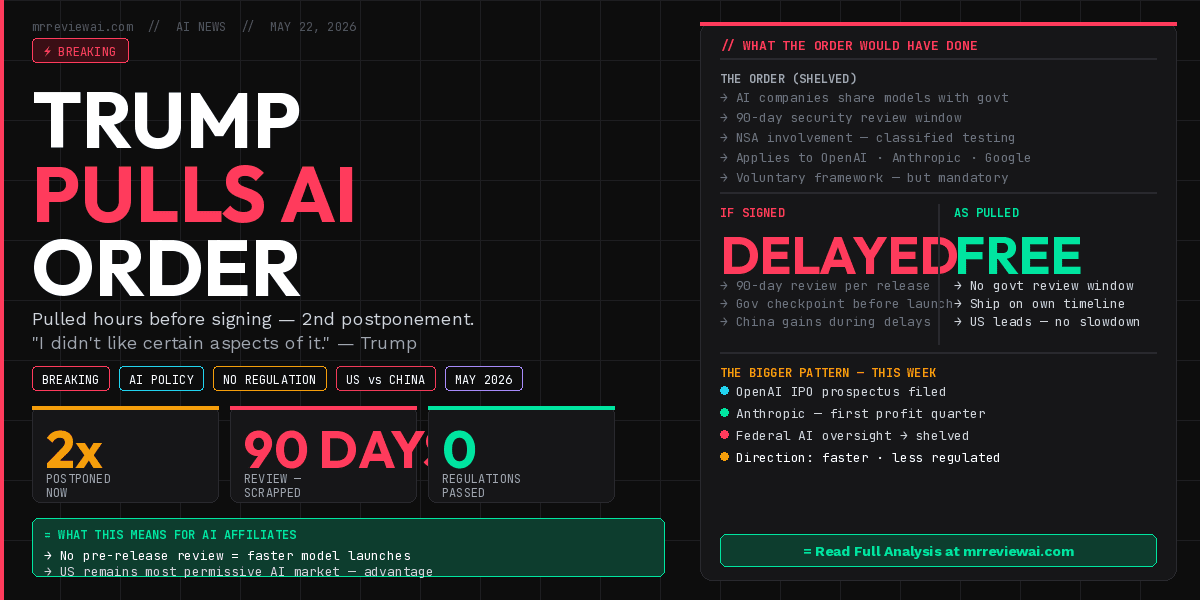
The Trump AI executive order that would have reshaped how the US government oversees artificial intelligence was pulled hours before its scheduled signing on May 21, 2026 — the second time this specific order has been postponed.
President Trump halted the signing at the last minute. AI companies including OpenAI and Anthropic had been in active negotiations with the administration over its terms for months. The ceremony was cancelled without a new date announced.
Trump’s explanation to reporters: “I didn’t like certain aspects of it.” He added: “We’re leading China, we’re leading everybody, and I didn’t want to do anything to get in the way of that lead.”
What the Order Would Have Done
The Trump AI executive order would have created a voluntary framework requiring AI companies to share advanced models with the federal government before public release. Federal agencies would have had up to 90 days to conduct security reviews, with NSA involvement in classified testing of the most powerful systems.
The stated purpose: protect government computer networks from emerging cyberthreats as AI models become more capable.
The practical effect: every major frontier AI release — from Anthropic, OpenAI, Google — would have gone through a government review window before reaching the public. That 90-day window, even as a voluntary measure, would have introduced a meaningful delay into the release cycle of the world’s most advanced AI models.
Why Trump Pulled It
The core tension is straightforward. The US is currently ahead of China in frontier AI development. Any regulatory friction — even voluntary, even 90 days — introduces a delay that competitors without those constraints do not face.
From Trump’s perspective, winning the AI race means not slowing down. The order was designed to protect national security. The president decided the tradeoff was not worth it at this stage of the competition.
This is the second postponement. The first delay came in April 2026. The White House has not announced a revised signing date.
What This Means for AI Companies
In the short term: no mandatory or voluntary pre-release review. OpenAI, Anthropic, Google, and Meta can continue releasing models on their own timelines without a government checkpoint.
In the medium term: the regulatory question does not go away. The Trump AI executive order was pulled, not cancelled. Some version of federal AI oversight is likely to return — the form it takes will depend on what happens to US-China AI competitiveness over the next 12 months.
For the AI industry, the current US regulatory environment is the most permissive of any major economy. That gap — relative to the EU AI Act and China’s generative AI regulations — is a structural advantage for US AI companies. The decision to keep that gap open is a deliberate policy choice.
The Bigger Pattern
Three major AI signals in one week. OpenAI filed its confidential IPO prospectus on May 22 targeting $1 trillion. Anthropic projected its first-ever operating profit at $559 million. And the Trump AI executive order — the one significant piece of federal oversight — was shelved for the second time.
The policy environment, the capital markets, and the competitive landscape are all moving in the same direction: faster, less regulated, higher stakes. For anyone building with AI tools or investing in the space, the regulatory tailwind is as strong as it has been at any point since ChatGPT launched in 2022.