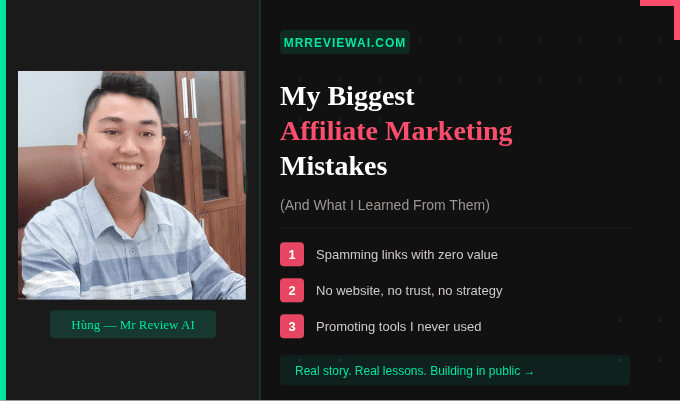
My Biggest Affiliate Marketing Mistake (And What I Learned From It)
Affiliate marketing mistakes beginners make are more common than you think — and I made most of them. Back in mid-2025, I was ready to make affiliate marketing work.
I had the energy. I had the ambition. I picked a niche I genuinely believed in — AI tools and SaaS products for online entrepreneurs.
What I didn’t have: a website, a strategy, or any real understanding of what my audience actually needed.
So I did what most beginners do. I set up pages everywhere — Facebook, Fanpage, Threads, LinkedIn — under the brand name Mr Review AI. I figured if I showed up on enough platforms, something would stick.
It didn’t.
The #1 Affiliate Marketing Mistakes Beginners Make
Here’s exactly what I was doing wrong: I was distributing links before I had earned the right to.
Every post I published was basically an ad. No context. No story. No useful information. Just “here’s a tool, here’s my link.”
Sound familiar? If you’re in the early stages of affiliate marketing, you’ve probably been tempted to do the same thing. The logic seems reasonable at first — more links = more chances to earn.
The reality is the opposite.
When you drop affiliate links without providing value, you’re not marketing. You’re just adding noise to someone’s feed. And people have learned to ignore that noise very, very quickly.
Why It Failed (The Real Reason) {
The surface-level problem was that I was spam-posting links.
But the deeper problem? I didn’t understand the customer.
I didn’t know:
- Who I was talking to
- What problems they were trying to solve
- What their day-to-day work looked like
- What would actually make them trust me enough to click — and buy
If you don’t know your customer’s pain, you can’t write content that resonates. And if your content doesn’t resonate, no one reads it. And if no one reads it, no one clicks your links.
I was promoting AI and SaaS tools to an invisible audience that I’d never taken the time to understand.
On top of that, I hadn’t used most of the products I was promoting. I was writing about tools I’d read about — not tools I’d actually worked with. Readers can feel that. Even if they can’t articulate why, they sense when a recommendation is hollow.
That’s when trust breaks down.
Giving Up — and Coming Back
I quit. Completely.
From late 2025 into early 2026, I stepped away from the whole project. The social accounts sat dormant. Mr Review AI was just a name with no real presence behind it.
But I kept thinking about it.
In May 2026, I decided to come back — this time with a completely different approach. Instead of jumping straight into social media posts, I started over from the foundation: I built a real website at mrreviewai.com.
A proper home base. A brand. A place where I could publish content that actually helps people.
Why now? A few reasons:
AI tools are genuinely powerful right now. The technology has reached a point where a solo creator can produce serious content with the right workflow. I’ve been using Claude AI as my primary assistant — it’s helped me design the site, optimize content for SEO, plan my content calendar, and troubleshoot technical issues when things break.
I understand the niche better. I’m not pretending to be an expert on every tool anymore. Instead, I’m building toward genuine experience — and in the meantime, I’m being transparent about where I am in that journey.
What I’m Doing Differently Now
Here’s the approach I’m taking this time around — and it’s the opposite of what I was doing before.
1. Website first, social second.
All content lives on mrreviewai.com. Social posts exist to drive people to the site, not to replace it. This gives me a platform I control, with SEO potential, email capture, and a professional face for the brand.
2. Share what I actually know.
I’m not going to write a 3,000-word review of a tool I’ve spent 20 minutes with. If I haven’t used something deeply, I’ll say so. I’d rather publish fewer honest pieces than more superficial ones.
3. Document the journey.
One thing I’ve realized: I don’t need to be a success story to have something worth sharing. The process of building this — the mistakes, the pivots, the small wins — is content. If I record what I’m doing and what I’m learning, that’s value. That’s something a beginner can learn from.
4. Build before monetizing.
Some of the affiliate programs I want to promote won’t accept my application yet. The brand is too new, the traffic too low. That’s fine. Instead of trying to force it, I’m focused on building the authority first — real content, real audience, real trust. The commissions come after.
The One Lesson That Changed Everything
If I had to reduce everything I’ve learned to a single principle, it’s this:
Give real value first. Earn the right to recommend second.
This sounds simple. It’s actually hard to internalize when you’re eager to earn.
The affiliate marketers who actually build sustainable income aren’t the ones who found the cleverest ways to drop links. They’re the ones who became genuinely useful to their audience — to the point where readers come back looking for their recommendation before making a purchase.
That’s the goal I’m working toward with Mr Review AI.
I’ve also learned that you don’t need to have it all figured out before you start sharing. You just need to be honest about where you are. If you learned something today, share it. If you made a mistake this week, write about it. That kind of raw, real content builds trust faster than a polished review of a product you’ve never touched.
Where I’m Headed
My goal is to build mrreviewai.com into a site that earns $10,000/month by end of 2028 — and eventually sell it on a platform like Flippa or Empire Flippers.
That’s a long-term plan. And I’m at the very beginning of it.
But I’m building in public this time. I’ll share what’s working, what isn’t, what tools I’m actually using, and what the real numbers look like as they develop.
If you’re somewhere in the early stages of your own affiliate marketing journey — or you’ve made some of the same mistakes I made — I hope this was useful.
Follow along if you want to see how this unfolds.
FAQ {#faq}
What’s the biggest mistake beginners make in affiliate marketing? Starting with promotion before building trust. If people don’t know who you are and don’t believe you’ve genuinely used a product, they won’t click your links — and even if they do, they won’t buy.
Do you need a website to do affiliate marketing? Not technically. But without a website, you’re dependent on social platforms that can change their rules anytime. A website is a home base you control, with SEO potential that compounds over time.
How long does it take to earn your first affiliate commission? It varies a lot. Realistically, most beginner bloggers don’t see their first commissions until 3–6 months in, and even then it’s often small. Anyone promising faster results without explaining the work involved is not being honest with you.
What AI tools are you using to build mrreviewai.com? Claude AI is my main assistant for content planning, writing, SEO optimization, and technical problem-solving. I plan to review the full stack of tools I’m using as I build more hands-on experience with each one.
How do I follow your progress? You can follow this blog and find me on Threads at @mr.reviewai and Pinterest at pinterest.com/mrreviewai.
This is an honest account of my own experience. I’m not where I want to be yet — but I’m building in public so you can learn from both my mistakes and my progress.
Frequently Asked Questions About Affiliate Marketing Mistakes
How long did it take you to realize you were making mistakes?
Longer than I want to admit. I spent my first four months promoting ElevenLabs voice AI to a blogger audience and earned zero commissions despite getting hundreds of clicks. The product did not match what my audience needed. That mismatch cost me months I cannot get back, which is exactly why I write about this now.
Can you actually make money with affiliate marketing in your first year?
Yes, but most people do not, and the main reason is they give up too early or target the wrong keywords from the start. I saw my first commission in month 5. My second did not come until month 7. Both came from posts I almost did not publish because I thought the topics were too small. Stick with it.
What is the single most important thing a beginner affiliate blogger should focus on?
Keyword research, every single time. You can write the best review in the world, but if nobody searches for the keyword you targeted, nobody reads it. I would rather publish a mediocre article on a well-researched keyword than a brilliant article that nobody finds.
How many affiliate programs should a new blogger join?
Start with two or three programs maximum. I was in seven my first year and it scattered my focus across too many products. When I narrowed to three programs that actually fit my audience, my content got sharper, my messaging got clearer, and my conversions improved significantly.
Is affiliate marketing still worth starting in 2026?
Yes. The market for honest, specific affiliate reviews is growing because most review sites are obviously sponsored or outdated. There is real space for a reviewer who actually tests tools and says what does not work. That is the gap I am trying to fill with this site, and it is working.
🎁 Free Weekly AI Tool Picks
Join 1,000+ bloggers getting tested AI tool recommendations every week. No spam, unsubscribe anytime.