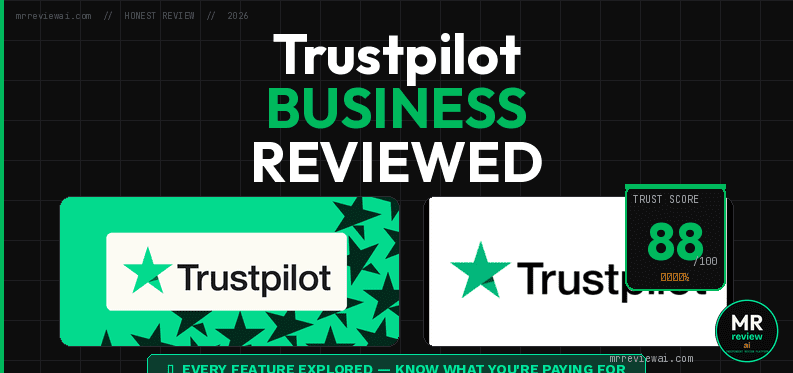
Trustpilot Business Review (2026): I Explored Every Feature So You Know What You’re Paying For

- ✓Industry-standard trust signal — recognized globally
- ✓Rich snippets boost CTR in Google search results
- ✓Automated review invitations on paid plan
- ✓Strong SEO impact — star ratings in SERPs
- ✕Free plan has very limited features
- ✕Paid plans start at $250+/mo for full automation
- ✕Trustpilot cannot remove fake reviews reliably
- ✕SaaS/software tools have limited benefit vs ecommerce
Bottom line upfront: Trustpilot is one of the most recognized review platforms on the internet — but for most small and early-stage businesses, the free plan is all you need. I just spent a full day inside the Trustpilot Business dashboard on the Free plan (exploring all feature pages including the Plus plan at $359/month), explored every section of the dashboard across 6 areas, and came away with one clear conclusion: the brand equity is real, but the pricing is a trap for businesses that aren’t ready for it.
📋 Disclosure: I signed up for the Trustpilot Business Free plan. I did not purchase Plus ($359/month) or Premium ($889/month). All screenshots in this article were taken from my actual Free account dashboard on June 17, 2026. I am not affiliated with Trustpilot and receive no compensation for this review.
📅 Last updated: June 17, 2026 · Plan tested: Free (with full view of Plus/Premium feature pages) · Account: Real verified business account (mrreviewai.com)
This is my hands-on Trustpilot Business review written from the perspective of a business owner — not a Trustpilot affiliate, not a software vendor with a competing product to sell. I run Mr Review AI, a platform dedicated to hands-on, first-person testing of AI tools and SaaS products. I reviewed Trustpilot the same way I review everything else: I signed up, I navigated every section, I documented what I found, and I’m going to tell you exactly what each plan offers — and what it costs.
Quick Verdict
Trustpilot Business score: 7.2 / 10
Best for: Global e-commerce brands and SaaS companies with 500+ monthly customers who need Google Seller Ratings for paid ads.
Not worth it for: Local businesses, early-stage startups, content sites, and anyone who isn’t ready to commit $4,300+ per year upfront.
Free plan verdict: Genuinely useful — claim your profile, respond to reviews, and start building trust at zero cost.
✅ Pros
- Free plan lets you claim your profile and collect reviews at $0/month
- TrustScore is globally recognized — consumers trust the green star badge
- Review Collector widget embeds on any site with no coding required
- 25+ integrations covering Shopify, WooCommerce, WordPress, Klaviyo, and more
- Automated email invitations via BCC — set up in under 3 minutes
- Public profile ranks in Google Search for your brand name
- 14-day free Plus trial — test all premium features before committing
❌ Cons
- Starter plan starts at $109/month — steep for small businesses with low review volume
- Businesses cannot remove or hide negative reviews (by design, but painful)
- Free plan limited to 1 TrustBox widget and no custom email templates
- In-app review collector requires Starter plan or above ($109/month)
- Analytics locked behind paid plans — free users get no performance data
- Review invitations capped at 50/month on free plan
- No QR code or SMS invitation methods on any plan
trustpilot — Rating Breakdown
Most recognized review platform globally — star ratings in Google SERPs
Claim page + basic widgets only — very limited without paying
$250+/mo entry — pricing not public, requires sales call
Good inbox + analytics — but cannot reliably remove fake reviews
Better for ecommerce — limited direct benefit for content sites
What Is Trustpilot Business?
Trustpilot was founded in Denmark in 2007 and is now publicly traded on the London Stock Exchange (LSE: TRST). As of mid-2026, the platform hosts over 330 million reviews across 714,000+ companies, with 60 million monthly active users. It is one of the most recognizable trust signals on the internet — when a consumer sees a Trustpilot star rating on a website, they recognize it instantly.
For businesses, Trustpilot operates as a two-sided platform. On one side, consumers can leave reviews of any business for free. On the other side, businesses pay for tools to collect more reviews, display them through embeddable widgets, and analyze their reputation data. The free tier lets you claim your profile and respond to reviews. The paid tiers — Starter, Plus, and Premium — layer on automation, analytics, and customization.
My Hands-On Test: Inside the Trustpilot Business Dashboard
On June 17, 2026, I set up a Trustpilot Business account and spent the day navigating every section of the dashboard — including the Plus plan feature pages. I documented exactly what each plan offers and where the walls are. Here is what I found across the six core areas.
1. Get Reviews — Invitation Methods
This is the heart of the paid product. Trustpilot gives you two main methods to invite customers to leave reviews.
The first is manual email invitations — you upload a CSV of customer emails and Trustpilot sends them a branded review request. On the Plus plan, you get 300 of these per month. That sounds like a lot until you realize a mid-size e-commerce store might process 2,000 orders a month and would hit the wall immediately.
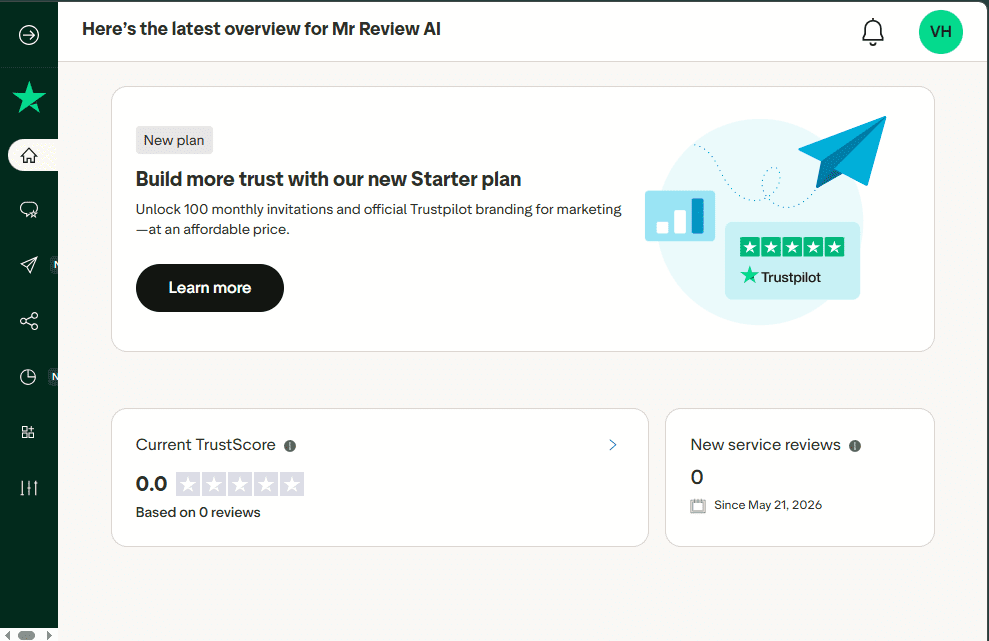
The second — and far more elegant — method is the Automatic Feedback Service (AFS). Trustpilot gives your business a unique BCC email address (mine was mrreviewai.com+e961b70dbf@invite.trustpilot.com). You add this address to the BCC field of your existing order confirmation or welcome emails. Every time you send a customer an email, Trustpilot silently captures it and sends them a review invitation automatically. No extra work on your end. This integrates with Gmail, Klaviyo, SendGrid, Zendesk, Shopify, WooCommerce, HubSpot, and 20+ other platforms.
I also explored the email template library. The templates are clean and well-designed — but building custom templates is locked behind the Premium tier at $889/month. On Plus, you get pre-built templates you can only lightly customize. This feels like an intentional friction point designed to push you to upgrade.
When setting up automated invitations, Trustpilot now offers two distinct paths: Quick set-up (their recommended option) where you simply add a BCC email address to your existing email tool and you’re done in minutes, and Customized set-up where you choose your email platform and control the template and send timing. Both are available on paid plans.
Trustpilot calls their embeddable widgets “TrustBoxes.” I counted 25+ widget types organized into four categories:
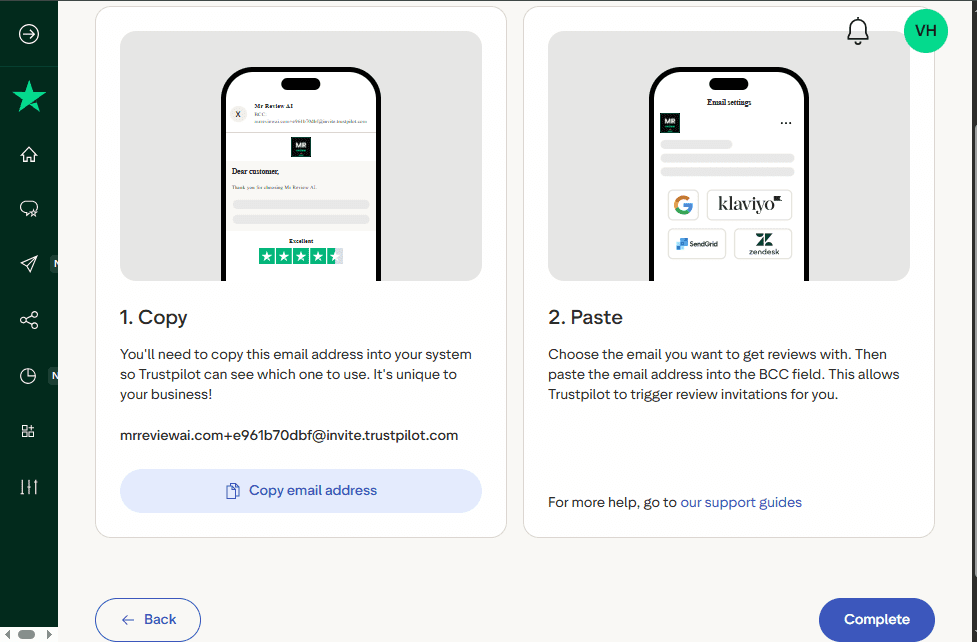
Essentials (score and rating display): Micro Review Count, Horizontal, Micro Button, Micro Combo, Micro Star, Micro TrustScore, Mini, Starter — these are the small badges you’ve seen on thousands of websites showing a star rating and review count.
Collect Reviews: Just one widget here — the Review Collector, which embeds a “Review us on Trustpilot” button directly on your site. This is the only widget available for free.
Testimonials: Carousel (popular), Drop-Down, Grid, List, List Filtered, Mini Carousel, Pop-Up, Quote, Slider. These display your actual reviews in various layouts. Most require a paid plan to unlock.
Product Reviews: Product Mini, Product Mini MultiSource, Product Q&A, Product Reviews, Product Reviews Carousel, Product Reviews Gallery, Product Reviews MultiSource, Product Reviews SEO. These are for businesses that want review widgets on individual product pages — think e-commerce. All locked behind paid plans.
The technical implementation is clean. Every widget uses a two-part pattern: one global loader script in your <head>, and a simple <div> with data attributes wherever you want the widget to appear. Lightweight and developer-friendly.
Beyond website widgets, the Share & Promote section also includes Email widgets (TrustBox Signature and TrustBox Newsletter for embedding your rating in outgoing emails) and a Social tools section with an Image Generator and Video Generator — letting you create branded social media content featuring your Trustpilot rating. These social tools are a newer addition I found in the dashboard that most reviews of Trustpilot don’t cover.
3. Analytics — Performance Tracking
The Analytics section is now labeled “Performance” in the dashboard and is organized into two main areas. The first is Performance, which has four sub-tabs: Overview (three KPI cards — Reviews collected, Invitations delivered, Current TrustScore — followed by time-series charts), TrustScore Insights, Service Reviews (a newer tab showing review sentiment and score trends), and Invitations. The second area is Review Insights, and there is also a separate Engagement section.
Since my account is new with zero reviews, all of my analytics pages showed empty states. But the structure is visible: three KPI cards at the top (Reviews collected, Invitations delivered, Current TrustScore), followed by time-series charts. The dashboard uses a 28-day default window with the ability to filter by date range and weekly/monthly intervals.
The Service Reviews analytics section — which is what most business owners actually want — is locked behind the Plus plan. This is the dashboard where you can see review sentiment trends, response rates, and score changes over time. The fact that Trustpilot gates this behind a $359/month plan is significant. You’re paying not just for collection tools, but for the ability to understand your own reputation data.
4. Manage Reviews — The Inbox
The reviews inbox is where you see all reviews left for your business and can respond to them. My inbox was empty (new account), but the layout is clean: filters for star rating, verified/unverified status, and whether you’ve responded. You can flag reviews that you believe violate Trustpilot’s guidelines, which sends them to the Content Integrity Team for review.
One thing worth noting: the ability to respond to reviews is available on the free plan. You do not need to pay to engage with your customers publicly. This is a genuine free feature, not a teaser.
5. Integrations — 25 Platform Connections
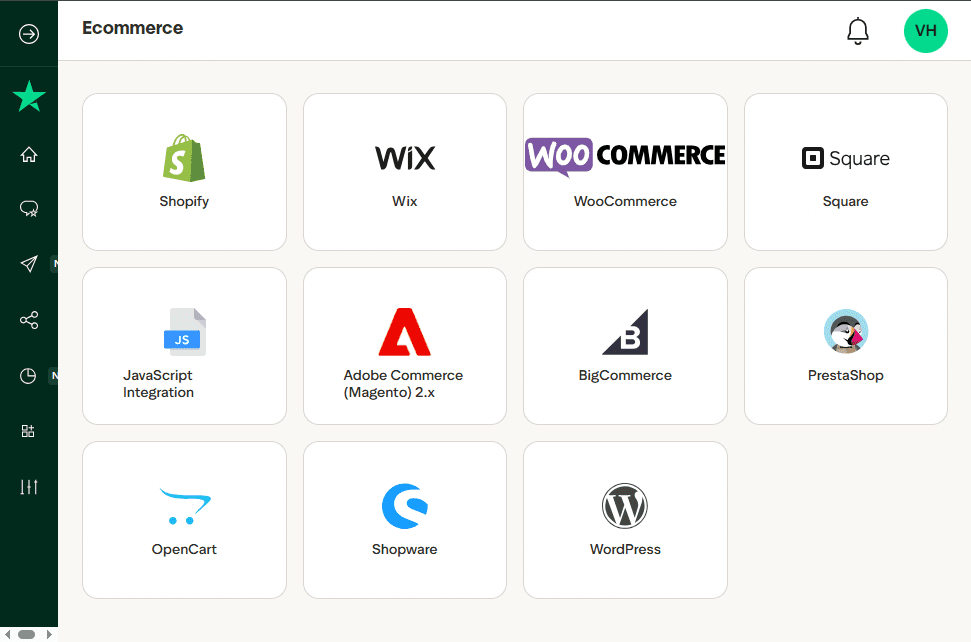
Trustpilot integrates with a comprehensive list of e-commerce and business platforms: Shopify, WooCommerce, Wix, Square, PrestaShop, Adobe Commerce (Magento), BigCommerce, OpenCart, Shopware, WordPress, PayPal, JavaScript Integration, HubSpot, Salesforce, Segment, Aftership, DotDigital, eDesk, Emarsys, isendu, Medallia, Shoplazza, Social Places, Visualsoft, and Zapier.
Trustpilot organizes these integrations into five categories inside the dashboard: Ecommerce (Shopify, WooCommerce, Wix, Square, Adobe Commerce, BigCommerce, PrestaShop, OpenCart, Shopware, WordPress, JavaScript Integration), Payment & CRM, Developers (for API access), Marketing, and Customer Support. This categorization makes it easier to find the right integration for your tech stack.
The WordPress integration deserves a special mention. Trustpilot offers a free WordPress plugin that lets you add TrustBox widgets via a drag-and-drop interface — no coding required. If you run a WordPress site, this is probably the easiest path to getting their widgets live.
6. Profile & Settings — Your Public Face
This section controls what potential customers see when they search for your business on Trustpilot. You can add your logo, company description, categories, contact info, and physical locations (for businesses that want location-based reviews).
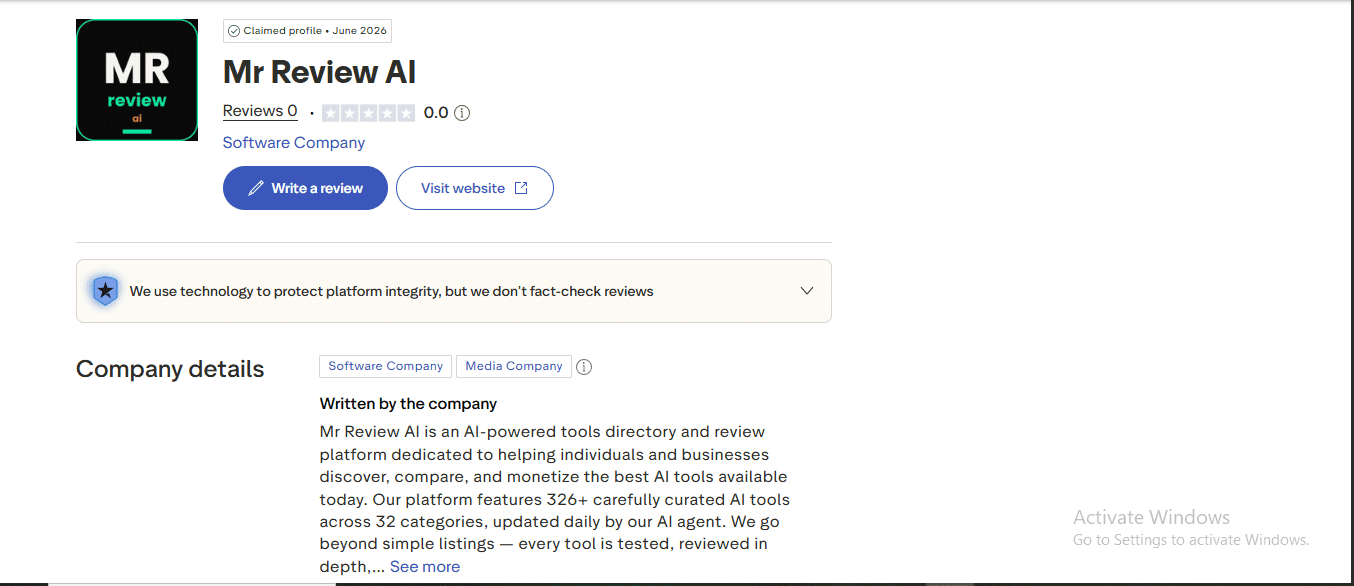
This is the actual public profile for Mr Review AI on Trustpilot as of June 17, 2026. We have 0 reviews — we are a new business and we are not asking friends or family for fake reviews. Our philosophy: if someone finds genuine value in what we do, they will leave a review. If not, that is honest feedback too.
One Plus-exclusive feature here is the Discovery Bar — a section on your public Trustpilot profile where you can showcase promotions, guarantees, and related businesses. Think of it as a mini landing page within Trustpilot’s ecosystem.
Another Plus feature: HTML customization of your company description. On the free plan, you get a plain text box. On Plus, you can add formatted HTML including images (under 312px wide, under 5MB). This lets you make your Trustpilot profile page look significantly more polished.
There is also a Sync with Google My Business button on the profile page — a useful feature for businesses that want their Trustpilot presence connected to their Google Business listing.
Trustpilot Pricing 2026: The Real Numbers
Here are the actual monthly prices I saw inside the dashboard on June 17, 2026. Note: these are monthly billing prices. Trustpilot also offers annual billing at 11% savings — but annual means paying upfront, which for Plus works out to over $4,000 committed at once.
| Plan | Monthly Price | Review Invitations | Widgets | Users | Domains |
|---|---|---|---|---|---|
| Free | $0 | 50/month | 1 (Review Collector) | 1 | 1 |
| Starter | $109 | 100/month | 2 | 1 | 1 |
| Plus | $359 | 300/month | 10 | 3 | Up to 3* |
| Premium | $889 | 1,000/month | 21 | 10 | Unlimited* |
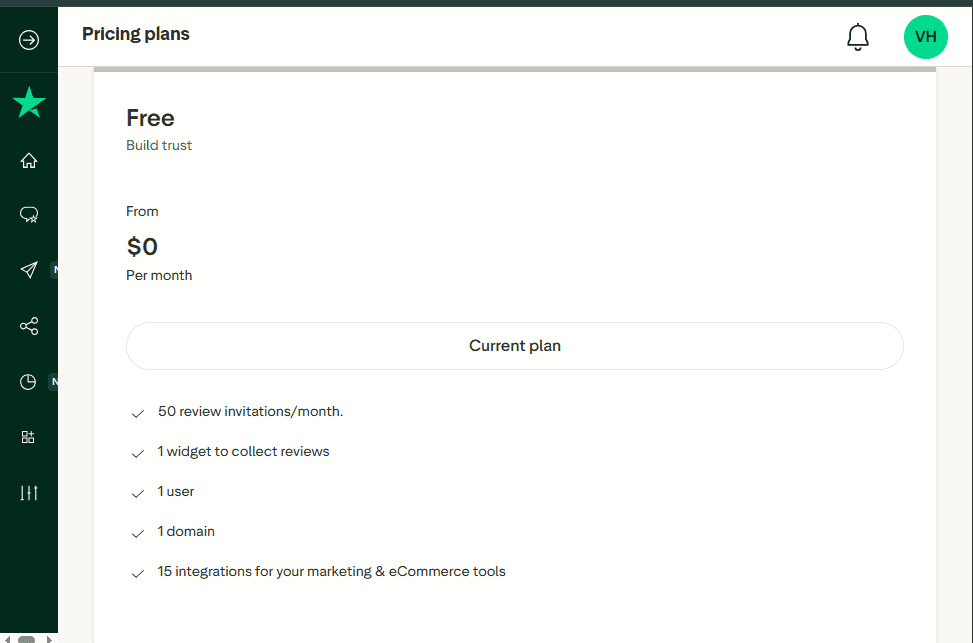
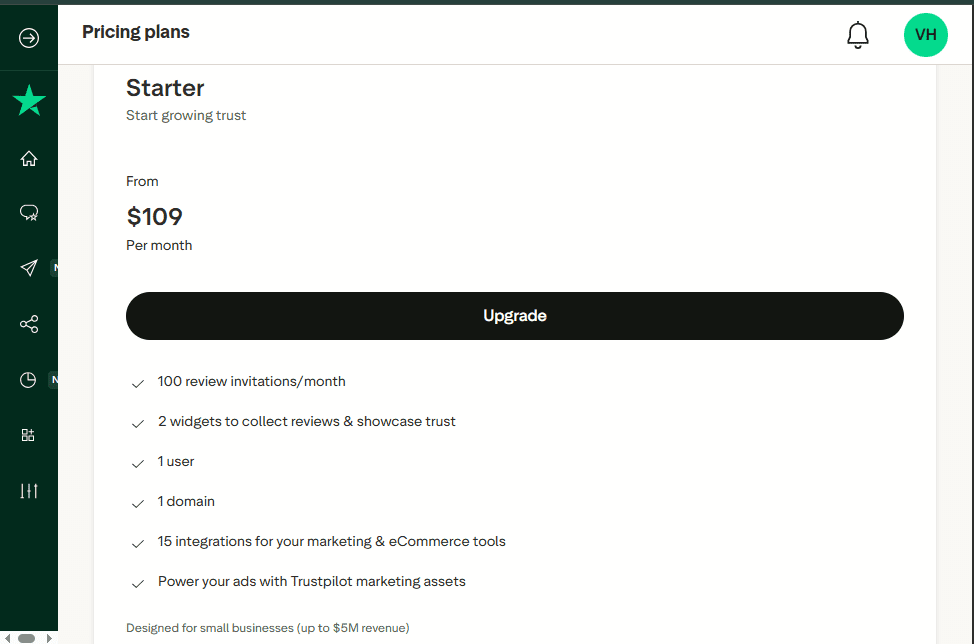
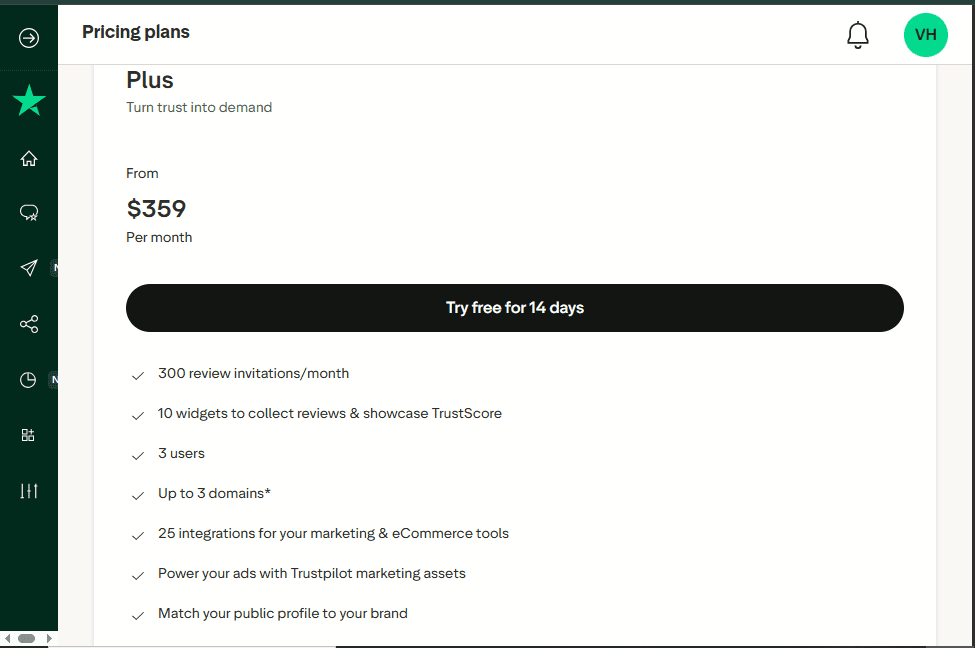
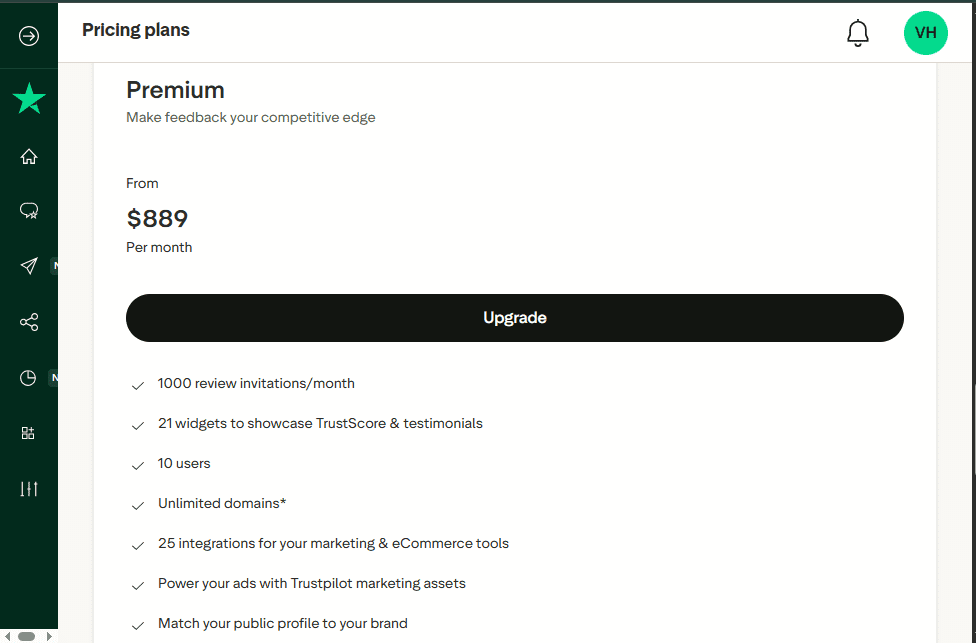
One critical detail that Trustpilot does not highlight prominently: contracts are a 12-month commitment. The pricing page states this clearly (“Contracts are a 12-month commitment. Pricing applies to new contracts.”), but it is easy to miss when you’re focused on the monthly number. If you sign up for Plus at $359/month thinking you can cancel after three months, you cannot — you’re committed to $4,308 for the year.
One thing worth noting that Trustpilot doesn’t advertise prominently: when I checked the dashboard in June 2026, there was an active 14-day free Plus trial offer available. This means you can test the full Plus feature set before committing to the annual contract. If you’re on the fence, take the trial, run your first automated invitation campaign, and measure the results before signing a $4,308/year commitment.
Is trustpilot right for you?
- ✓ You run an ecommerce store that needs trust signals
- ✓ You get 50+ customer transactions per month
- ✓ You want rich snippets (star ratings) in Google search results
- ✓ You're building brand credibility for a B2B SaaS product
- ✓ You can justify $250+/mo against increased conversion rates
- ✕ You run a content site or blog — limited direct ROI
- ✕ You're a solo creator or small affiliate site
- ✕ You can't commit to $250+/mo — Google Reviews is free
- ✕ You expect to remove negative reviews — Trustpilot can't guarantee this
- ✕ You want quick setup — onboarding and pricing require sales calls
Who Should Actually Pay for Trustpilot?
After testing the platform and researching how businesses actually use it, here is the honest framework I would give any business owner asking whether to pay:
Pay for Trustpilot if you meet ALL of these criteria:
You sell globally, not just locally. Trustpilot’s brand recognition is highest in Europe, the UK, the US, and Australia — if that’s where your customers are, the trust signal carries real weight.
You run Google Ads and want Google Seller Ratings. The golden stars that appear in paid search ads come from Trustpilot (and a few approved partners). Studies consistently show 10–15% CTR improvement from seller ratings. If you spend significant money on Google Ads, this alone can justify the cost.
You process 500+ transactions per month. At that volume, the automated invitation tools start to pay for themselves through review velocity. Below that threshold, the per-review cost is high.
You’re in a high-trust-required category: finance, SaaS, travel, direct-to-consumer health, or crypto. Customers in these verticals research extensively before buying, and an independent review platform carries more weight than testimonials on your own site.
Stick with the free plan (or skip entirely) if:
You’re a local business. Google Business Profile reviews matter 10x more for local search visibility than Trustpilot. Put your energy there first.
You sell primarily through a marketplace (Amazon, Etsy, Shopify App Store). Platform-native reviews do more for your conversion rate than an external review site.
You’re early-stage with under 100 customers. Build the product, build the relationships, let reviews come organically before paying for collection infrastructure.
You need product-level reviews. Trustpilot is primarily a service/company review platform. For individual product reviews with photos and verified purchases, dedicated tools like Yotpo or Reviews.io are better suited.
Hidden Costs and Traps Business Owners Miss
Beyond the headline pricing, there are several structural issues that consistently surprise business owners who sign up for Trustpilot paid plans.
The per-domain pricing. The Plus plan covers one main domain. If you operate multiple regional sites — a .com, a .co.uk, a .au — each additional domain requires a separate plan purchase. For a multi-market business, this can multiply your costs quickly.
The invitation cap hits fast. 300 invitations per month on Plus sounds generous until you realize your email platform is already sending thousands of order confirmations. The AFS feature is brilliant, but it’s subject to the same cap. Businesses with real volume hit the ceiling and face pressure to upgrade to Premium ($889/month) for 1,000 invitations.
Support quality drops post-sale. The most common complaint from paying Trustpilot business customers — consistently across G2, Reddit, and BBB reviews — is that sales support is attentive before you sign, and largely unresponsive afterward. Dispute resolution for flagged reviews can take weeks, with little communication on status.
The paid-tier moderation asymmetry. Paying businesses have access to more tools for flagging and disputing reviews than free accounts. Trustpilot maintains that the same rules apply to all reviews regardless of subscription status — and that is technically true. But a paying business with a dedicated account manager and a systematic flagging workflow will move disputes through the system faster than a free account submitting support tickets. Over time, this creates a structural advantage for paid subscribers in how their review profile looks.
You don’t own the data. Every review on Trustpilot belongs to Trustpilot’s platform. If you stop paying, your reviews stay on their site — you lose the tools to actively manage and respond, but more importantly, you lose the collection infrastructure you built. Your review history is an asset on their platform, not yours.
What You Actually Get on the Free Plan
The Trustpilot free plan is more useful than most people realize, and more than enough for early-stage businesses. Here is what you get at zero cost:
Claim and verify your business profile. This is the most important step regardless of whether you ever pay. Your Trustpilot profile will exist whether you claim it or not — claim it so you can control the information displayed and respond to any reviews that come in.
Respond to all reviews publicly. This is a meaningful free feature. Professional, thoughtful responses to both positive and negative reviews are visible to anyone who views your profile and demonstrate that your business takes customer feedback seriously.
50 manual review invitations per month. For a small business, 50 targeted invitations to your best customers per month is not nothing. Send them to customers you know had a great experience and you’ll build a review profile authentically over time.
One embeddable widget (Review Collector). You can put a “Review us on Trustpilot” button on your website for free.
Basic company profile customization. Logo, description, categories, contact info.
Best Alternatives to Trustpilot for Businesses
Depending on what you’re actually trying to accomplish, there may be better tools for your specific situation.
Google Business Profile (Free) — If you’re a local business or service provider, this is where to focus first. Google reviews directly affect local search rankings and map visibility. A 4.8-star Google rating with 50 reviews will drive more local customers than a 4.8-star Trustpilot rating with 500 reviews.
G2 or Capterra — If you sell B2B software, your buyers are on G2 and Capterra before they’re anywhere else. A strong G2 profile with detailed, verified reviews from real users in your category will generate higher-intent leads than Trustpilot, which is more generalist.
Reviews.io — A Trustpilot alternative that starts around $29–$49/month, includes photo and video reviews, and supports Google Seller Ratings without forcing a 12-month annual commitment. Worth evaluating if you need the Google Ads integration but want more flexibility.
Yotpo — Strong free tier, excellent Shopify integration, built around product-level reviews with photos. Better for e-commerce brands that want reviews tied to specific products rather than the overall company experience.
Your own site’s review section — Often undervalued. Reviews displayed directly on your own website, properly structured with schema markup, contribute directly to your SEO and conversion rate. You own the data completely.
🔬 What I Tried But Couldn’t Fully Test
I tested Trustpilot on the Free plan with a brand-new account (0 reviews). Some features require paid plans or real customer volume to evaluate properly:
- AFS email deliverability — I set up the BCC address but had no real customers to send to. Claimed 90%+ delivery rate, unverified by me.
- Google Seller Ratings — Requires 100+ reviews collected within 12 months. Not achievable in my test window.
- Analytics dashboard — Locked behind Starter ($109/month). I could see the menu structure but no real data.
- Premium plan features ($889/month) — Custom review forms, dedicated support, advanced API. Not tested due to cost.
- Review flagging system — I had no fake reviews to flag, so I couldn’t test how quickly Trustpilot’s moderation team responds.
Final Verdict: Is Trustpilot Business Worth It?
Trustpilot is a legitimate, well-run platform with genuine brand authority. The trust signal it provides is real — consumers recognize and trust the logo, and the Google Seller Ratings integration creates measurable value for businesses running paid search campaigns.
But “worth it” depends entirely on your stage and context. For a global e-commerce brand processing thousands of orders per month and spending heavily on Google Ads, a paid Trustpilot plan is a rational investment. For an early-stage business, a local service provider, a content site, or a B2B software company, the pricing structure creates more friction than value — and better, cheaper alternatives exist for each of those use cases.
My recommendation: claim your free Trustpilot profile today. Respond to every review that comes in. Send your 50 monthly invitations to customers who you know had a strong experience. Let the profile build organically. Then — only when you’re processing real volume, running Google Ads, and have exhausted what the free plan offers — evaluate whether a paid plan makes financial sense for your specific numbers.
The worst move is signing a $4,000+ annual contract before you have the review volume and ad spend to justify it.
Building Credibility for Your AI Tool Site?
See how mrreviewai.com approaches trust, E-E-A-T, and editorial standards — and the tools we use.
FAQ
Is Trustpilot free for businesses?
Yes. Trustpilot has a genuinely useful free plan that lets you claim your profile, respond to reviews, send 50 manual review invitations per month, and embed one basic widget on your website. You do not need to pay to have a functional Trustpilot presence.
How much does Trustpilot cost for businesses in 2026?
Trustpilot’s paid plans start at $109/month (Starter), $359/month (Plus), and $889/month (Premium) — see official pricing page on monthly billing. All paid contracts are 12-month commitments, which means you pay annually upfront. The Plus plan works out to approximately $3,200/year on annual billing (11% discount applied).
Can businesses pay to remove negative Trustpilot reviews?
No. Trustpilot does not allow businesses to pay to remove negative reviews or purchase a higher TrustScore. Businesses can flag reviews they believe violate Trustpilot’s content guidelines, which are then reviewed by the Content Integrity Team. The outcome is based on whether the review breaks the rules, not on the subscription level of the business.
What is Trustpilot’s Automatic Feedback Service (AFS)?
AFS is a feature where Trustpilot provides your business with a unique BCC email address. When you add this address to the BCC field of emails you send to customers (order confirmations, welcome emails, etc.), Trustpilot automatically captures the customer’s email and sends them a review invitation. It integrates with Gmail, Klaviyo, SendGrid, Shopify, WooCommerce, HubSpot, and 20+ other platforms. AFS is available on paid plans.
Is Trustpilot better than Google Reviews for businesses?
It depends on your business type. For local businesses and service providers, Google Business Profile reviews are significantly more valuable because they directly affect local search rankings and map visibility. For global e-commerce brands and SaaS companies, Trustpilot provides the independent third-party trust signal and Google Seller Ratings integration that Google Reviews do not. Most serious businesses use both.

About the Author
Mr Review AI Team
This review was researched and tested hands-on by the Mr Review AI editorial team. We create real accounts, run actual campaigns, and document every limitation we encounter — no vendor demos, no copied spec sheets. Our reviews are editorially independent: no tool pays for a score or placement, ever. Where we have affiliate relationships, we disclose them transparently on each page.
Want to know who founded this site and what drives our editorial standards? → Meet the founder on our About page